The dreaded email arrives at night. We are having an emergency faculty meeting before school tomorrow. Your heart immediately sinks. You have already heard the whispers. You know something terrible has happened.
You rush to school. The meeting has started. It sucks. Everyone is crying or awkwardly standing around. The proverbial black cloud has arrived and will not leave anytime soon. You hear the words being said by your leader yet it all seems surreal.
How do we process when terrible things happen to young people? There is no silver lining. No circle of life justification that makes it better, like when your grandmom passes after holding her grandchildren. There is no blame we can place, fairly or not, like when someone smoked their whole life and died from cancer or someone never exercised or watched their diet and succumbed to hypertension or diabetes.
There is nothing to say other than life is unfair. I am jealous of the devoutly religious in these cases. The burden that is lifted from their shoulders due to their steadfast beliefs in purpose and better places allows them a peace that will elude the rest of us.
The only good thing that arises is the reminder to appreciate life a little more and cherish each interaction like it may be the last. Remember that time is finite. We will never have enough. No one is guaranteed a tomorrow. Appreciate what you have. Be grateful for all the goodness that exists in our lives. Remember why we teach and push out the negativity that comes from everything outside of our classrooms.
Throughout our journey in life, we inevitably encounter numerous valuable lessons that shape us as individuals. As we navigate the highs and lows, both triumphs and missteps contribute to our growth as human beings. Among these valuable insights, one stands out as the most important: the significance of being critical—of ourselves, others, and the world around us. In this pursuit, introspection becomes a powerful tool to examine our beliefs and behaviors, and how well they align with each other.
Just as a sports team reviews game films to engage in honest conversations on how to improve, we must adopt a similar mindset when reflecting on our actions, decisions, and interactions. This concept of criticality extends beyond our individual lives and should permeate into our professional endeavors and the organizations we associate with.
Taking a critical lens to our profession can make meaningful change. We have witnessed the pendulum swing towards a more just and inclusive health and physical education field. Notably, we observe positive shifts in areas such as elementary school fitness testing, the reconsideration of dodgeball, and the adoption of skills-based health education. These changes reflect our collective commitment to evolving and ensuring equitable opportunities for all learners.
In this thought-provoking guest blog, we delve into the partnership between SHAPE America and the Marine Corps. As we advocate for criticality in all aspects of our lives, it becomes crucial to apply this lens to such collaborations because we genuinely care about the betterment of our profession. Who better to scrutinize this partnership than an individual who occupies both worlds—an esteemed educator in health and physical education, as well as a veteran?
Therefore, I invite you to engage with this blog using the same critical lens that we apply to ourselves and our teaching practices. Embracing this perspective prompts meaningful conversations, enabling us to introspect, challenge prevailing notions, and drive positive change within ourselves, our professional community, and SHAPE America. By undertaking this journey of self-reflection together, we contribute to an ongoing dialogue that shapes the future of our field.
Thank you for dedicating your time to exploring this guest blog, and my gratitude extends to the author who penned these insightful words. Let us embark on this conversation together, fostering growth and development within ourselves, our profession, and our shared aspirations.
Guest Post:
One of the best things about being an independent organization is that we can influence change from the outside. And that’s exactly what this blog post aims to do. Today, we delve into the partnership between SHAPE America and the US Marine Corps. While collaborations between organizations can bring about positive outcomes, particularly in terms of financial support, it is crucial to examine the implications and alignment of such partnerships with the values and goals of SHAPE America.
From the Marine Corps perspective, the objective of this partnership is to legitimize, normalize, and increase military recruiters in schools. While I have no problem with people joining the military (I’m proud of my service), I don’t believe we should be trying to influence children along that path. They are more easily influenced and don’t fully understand the complexity of military service. Personally, I didn’t enlist until I was 22 years old. While I was not a wise old man, I certainly understood the world better than high school students did. It really is a “grown up” decision.
And maybe it wouldn’t be as bad IF recruiters were open and honest about issues in the military and veteran care. It is essential for recruiters to openly discuss both the advantages AND disadvantages of military service with students, enabling them to make informed decisions about their future. As someone who went through the enlistment process and even assisted recruiters after completing Marine Corps boot camp, I have first-hand knowledge that this is not what happens. There is a lot of misleading and lying by omission.
And schools are not the only environment where recruiters attempt to influence children. Recently the Army tried using esports to help desensitize young individuals to the realities of war. Fortunately this initiative faced a significant backlash from the youth who continuously questioned the morality of warfare and our country’s history. The result? The US Army retreated from Twitch as their recruitment drive backfired.
So how does the Marine Corps’ goals of this partnership align with SHAPE America’s stated goals and values? Our profession advocates for social justice and health, making it imperative to scrutinize whether this collaboration serves these principles. And this is not the only partnership that should be evaluated. I think we as a profession should think about what inclusion and exclusion criteria we want for ALL partnerships. What are the desires and expectations of SHAPE America’s members? Are we willing to bend our values if it lowers membership and conference rates?
In conclusion, this blog post attempted to shed light on the partnership between SHAPE America and the Marine Corps, highlighting the concerns surrounding military recruitment practices. As an independent organization SHAPE America has the power to influence change and shape the future of health and physical education. It is essential for us to engage in open and critical discussions about the alignment of partnerships with our values and goals, ensuring that we prioritize social justice, health, and the well-being of young individuals.
This weekend I saw reality bend to an individual. This is not hyperbole, embellishment, or exaggeration. The idea was sparked years ago through multiple conversations, arguments, debates, and dissension around people’s hatred of icebreakers. The smoke came first. Wisping through the air like an engine on fire in the distance of a traffic jam. The smoke arrived in the form of disbelief that teachers honestly didn’t enjoy human interaction with each other. With each exchange, I could see the idea being formed through the wavy lines of the increasing heat. “How can I create human interactions that aren’t poorly created, that have a purpose, and don’t seem like forced vulnerability?” When the inevitable inferno started sucking in vast amounts of oxygen to keep itself alive and the flames rose the idea was fully formed. Dr. Valeria Brown stated aloud that her dream was to create a conference around human connection.
You may be reading this and saying that there are lots of conferences every day across the nation what is so reality-bending about that? The incredible part of what I saw this weekend was not that there was an education conference; it was the precision and vision that was created first in her mind and then willed into existence.
This conference was going to be Val’s dream of what professional development could be. A day where joy would hold hands with vulnerability. A eutopia of learning where humanity would be the theme and love would be the decorations.
Val told us exactly what she wanted. Her idea was less the road less taken and more the road that was never created. The destination was clear as the North Star and the path was as clear as the ocean on a moonless night. There was no funding, no place for it to be held, and no guarantee that anyone would show up.
She secured the funding with the help of the very people who she has helped over the years through a Go Fund Me as well as other donations. Dr. Kate Spence stepped in and was able to provide us with a space at Fairleigh Dickinson University that had everything you could possibly imagine. The moon glistened off the ocean waves. The path was lit.
You will read below exactly what made the Education Conference for Human Connection the best conference that has ever been created before or will possibly exist again.
The doors to the Monninger opened and on the registration table sat the typical litany of pins, name tags, sign-in sheets, and wifi directions. The music filled the air with a chill vibe. There were no signs that this was going to be the conference of all conferences. You were directed upstairs and you see a free breakfast buffet that has eggs, potatoes, fruit, coffee, danishes, and muffins. Educators usually aren’t treated like this!
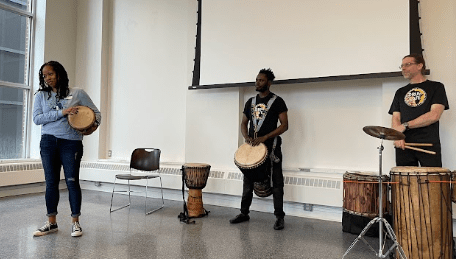
Breakfast ends and the beats of drums start to echo out of the ohrangerie. Yes, the ohrangerie. A former orange citrus greenhouse that is now a beautiful room with statues, a piano, a pool table, and floor-to-ceiling windows. The drumming was coming from a group called Drum Cafe. This was not the ordinary keynote you would have expected.
Each person was given their own drum that was hand-made in Africa. We were led through a variety of activities that created the very feeling of community that Val had imagined. We played solo, split in half, and used call and response all while finding joy together. The closest description I can give to the experience is the feeling you get at the end of an intimate concert that exceeded your expectations. You feel closer to the people you went with. You shared in something special and you all knew it. Our hearts were open and vulnerability was achieved. Any illusion that this was going to just be another conference quickly disappeared.
After the drums, Scott Bayer (@Lyricalswordz) was up. Now Scott did not know he was going to be running a session directly after a group that has over 45,000 performances in 80 countries. No pressure Scott! Much like Lamont Butler from SDSU, Scott was cold blooded and stepped up with the perfect activity. Around the room were 11 different quotes from books, songs, and poems. Our job was to discuss with our partners or groups how the quote made us feel in our hearts, heads, and guts.
With quotes coming from Clint Smith, Octavia Butler, and Lauryn Hill this was bound to poke at your feeling like an annoying younger sibling in the car on a road trip. The drums helped us become a community and become vulnerable. Scott’s activity allowed us to enter that vulnerability with each other. This conference was shaping up to be something special!
After Scott’s session, we broke up and you could choose Art as Activism & Healing with Lizzie Fortin (@lizziefortin) & Tiferet Ani (@tmalkaa) or Creating Classroom Community with Theresa Bunner (@RdngTeach).
LIZZIE!!!
I ended up going to Theresa’s session. The session was great. What made it even better was the people that were there. My first partner for the activity was Tricia Ebarvia (@triciaebarvia). We were given one minute to ask all about the things that we don’t know about our partner. The partner was then given two minutes to answer anything they were comfortable answering or talk about anything they wanted. This was a nice twist on an old idea. I knew a decent amount about Tricia already so I was able to ask some more delving questions. I walked away with a better understanding of who she is a mom as well as an educator.
My next partner was a fantastic human named Chandra. We did a cool activity with legos. We were sitting back to back and each had the same bag of legos. My legos were already completed into a creation. Chandra’s bag had the legos broken down. Our job was for me to communicate to Chandra how to replicate the creature. I wasn’t allowed to use numbers or colors. We were able to pass the test without me messing us up too badly. Again the activity was fun and the people made it better.
After the session, it was lunchtime. Yep, another free male catered with healthy choices and low sodium. This was shaping up to be special!
The next session was a full group session that was virtually run by Cherilyn Barrett called Connecting with Deaf Students. In the session, we learned about various tools that help our deaf students as well as different modifications we could make. Once again Val is thinking about marginalized groups that are underrepresented in education.
Following this session, we split up again. Tricia Evarvia and Chandra Singh were offering a dope session called Community Inside and Outside the Classroom. I really wanted to see and support this session and I couldn’t ignore that Ralph Pantozzi (@mathillustrated) had a session called Meet, Play, Move. I wanted to move it move it!
Ralph’s session was super fun! Once again the people made the session. Val, Scott, Kate, Nolan and everyone else I am forgetting to name came together to dig deeper into the meaning of play and how it shows up around us.
It was time for the final session of the day. I was psyched! Epic Theatre Ensemble was here. “Epic’s artists challenge the institutional status quo by making theatre radically accessible, engaging thousands of students and first-time audiences in the transformative process of telling their own stories and learning to deeply empathize with those of others.”
Four young powerful women mesmerized us with their dialogue and ability to tap into the emotion of racially charged subjects. One of their pieces consisted of performing excerpts of interviews they did with teachers, admin, and superintendents. They also wrote and performed responses to those interviews.
Once the performance was over the four young women sat for a Q and A. It was inspiring to hear how much passion they had for social justice. Their awareness of self and ability to tap into the anger and pain being caused in schools right now hit hard. This was the perfect way to end the sessions.
After Epic finished dinner was ready to go. Another fantastic meal with healthy options and dietary restriction friendly.
The biggest unknown of the night was up next. Val trusted my judgment and we booked DJ Reggie. Dr. Brown had no idea who he was or what he was about. I assured her that this man brings the heat! Reggie shows up and gets started. While he is djing a tornado watch goes into effect! Reggie had us dancing salsa, doing the gritty, and making up line dances. Every person danced! We danced through a tornado!!
The best part of the night happened next. While Reggie was djing the FAU vs. SDSU basketball game was on behind him. Once he finished there were about five minutes left in the game and we turned up the volume. Everyone was rooting for FAU. Lamont Butler stole that joy from us. (along with the two horrible calls from the ref down the stretch) When his shot went in the whole party jumped out of their chairs. It was an epic moment. (call back!)
Sunday morning came quicker than expected. Once again a catered breakfast awaited. Val did the final debrief and I ran a couple of activities that focused on joy and community.
With the conference summary done, I would like to go back to my earlier statement, “This weekend I saw reality bend to an individual.” Dr. Valeria Brown created a community called Clear the Air. She then envisioned a conference that would change the way we saw conferences. AND she set a bar for herself that Dick Fosbury himself would have had a hard time getting over. Dr. Brown managed to find the funding, gather her people, get the perfect performers, trust in her people they would show up for her, and show that it is possible to have an educator conference that fosters human connection.
I dislike the guiding principles of ‘broad‘ and ‘balanced‘ when it comes to thinking about the PE curriculum and the selection of activities and sports within it. They are vague, they don’t help the design process and they don’t really apply to an individual subject but to a school curriculum (for a nice critical perspective read Colin Richard’s Impact magazine article Broad? Balanced? Curriculum?). However in attempting to remove these principles from people’s thinking I have been met with strong resistance. They are (in PE Departments in England) a sticky concept that has created inertia to more contemporary ways of thinking about PE curriculum design and activity selection. Rather than advocating for binning them, perhaps a better starting point is to consider other options of ‘breadth and balance’ beyond the dominant ideas a range of sports or ensuring each activity area is accounted for.
The whirlwind of SHAPENJ’s 103rdconference is over for me. It started early on Super Bowl Sunday. A handful of dedicated people showed up before the convention in order to get the registration booth organized, set up the convention hall, and do the other million things that need to be done at the last minute.
Once this was done we were able to breathe and get ready for the Super Bowl! The game was awesome and the people were even better. A crooked pool table wasn’t going to ruin the night for us!! Once the game was over it was time to get ready!
Monday morning came way too quickly. I was able to shove some food and drink down my throat and then was ready to hear the keynote and start the day! Kevin McGrath was the keynote speaker. As an aside, all I want from a keynote speaker is someone who can allow me to laugh, allow me to cry, and give me one actionable thing to do in the future. It is no small feat. Kevin did all that and more. His story is amazing and I can’t wait to get him on the Shapes of Identity podcast! What Kevin is doing is amazing. It is truly a story of love for humanity.
“Adopt-a-Gym is a “by kids, for kids” fundraiser where schools raise funds to purchase physical education equipment for other schools that are short on resources to purchase adequate equipment for themselves.”
KEVIN get no financial compensation out of this fundraiser! That is the true definition of agape (selfless love). Check out more about his project here. You can follow Kevin on the Twitter @AdoptAGymKM.
The sessions were amazing as usual. There were so many health and physical education sessions that I was able to create a smorgasbord of professional learning to suit my soul as well as my profession. Candace Young, Brian Devore, John Jones, Victor Spadaro, Dan Rice, Mike Kuczala, Nick Kline, Thomas Gelardi and so many more presented fantastic sessions.
One particular session that touched my heart was the Attitudes in Reverse program. Tricia Baker story and delivery were engaging and informative. It was both heartbreaking and encouraging to hear her story and learn more about suicide prevention.
“Attitudes In Reverse’s (AIR’s) mission is to create a community of understanding, kindness and empathy through mental health education and awareness. AIR offers many programs that, when combined, remind students throughout the year that there are many people, perhaps their friends, family members or classmates, who may be living each day with mental health disorders. We must always be kind – no matter what people’s differences are. We must understand that NO ONE CHOOSES to have a mental health disorder.
AIR strives to provide unlimited mental health awareness and suicide prevention programs to youth and young adults, regardless of their ability to pay. AIR aims to inspire hope for those suffering from mental pain to seek assistance while instilling empathy and understanding of mental health disorders throughout society.”
I would highly recommend you go to their website for programs and resources to teach in your health and physical education programs. Also, there were dogs. Everyone wins when dogs are involved!
Heath Moves Minds was in full effect! The booth was rocking and the information was readily available. Most importantly our students will benefit socially and emotionally! Learn more about them here.
My final thoughts focus on relationships. Conferences are about information, participation, and most importantly relationships. Over the course of 15 years, I have gotten to know so many educators. This allows the conference to morph into reconnecting with old friends as well as learning. SHAPE NJ does a great job of fostering community by creating FREE events for the people who stay there. Monday night they had a bonfire on the beach and Tuesday night they have a band and the exhibitors bring their games to play. It is hard to leave our obligations in life I get that. And part of nourishing the soul is connecting with others. I highly recommend this conference to all educators.
Glow: Free food. Breakfast and lunch were covered! The food was amazing. So many healthy options. Oh and free coffee!
Glow: Kevin Mcgrath. Nuff said
Grow: It’s been five years since the left hotel door entrance worked!! Cmon man!
Glow: Therapy Dogs
Glow: Bonfires and Bands
Glow: Judy Lobianco. Her energy and passion are unparalleled. We are going to miss her next year.
Whenever people talk about what is the most important thing in education you always hear relationships. Relationships matter. The three R’s. Relationships. Relationships. Relationships. Everyone agrees relationships are important.
The value of relationships to me cannot be overstated. It would be like trying to describe how great pizza is. How underrated putting mayonnaise on the outside of a grilled cheese sandwich is. (Thanks Christina Torres Cawdery) Or just how much fun Wordle is. We simply can’t exaggerate how powerful each of those things really are.
Once I realized how important relationships are I wanted to become better at them. The first way I worked on this was by using my assertive listening skills.
“Active listening involves listening with all senses. As well as giving full attention to the speaker, it is important that the ‘active listener’ is also ‘seen’ to be listening – otherwise the speaker may conclude that what they are talking about is uninteresting to the listener. Interest can be conveyed to the speaker by using both verbal and non-verbal messages such as maintaining eye contact, nodding your head and smiling, agreeing by saying ‘Yes’ or simply ‘Mmm hmm’ to encourage them to continue. By providing this ‘feedback’ the person speaking will usually feel more at ease and therefore communicate more easily, openly and honestly.
Once I realized how important active listening was, I tried to be aware of each interaction I have with others. I have ADD so one of the hardest things for me is to not interrupt others when they speak. My struggles also lie in listening to understand instead of listening to respond. If you have interacted with me via face-to-face or phone call I am sure this is no surprise to you. I still fail at waiting to respond, or listening to understand sometimes; however, I am much better at it now. I work hard to improve because I know that listening is vital to creating and maintaining positive healthy relationships.
The next part of relationships I learned was important was via Dr. Angela Dye (@ejuc8or) author of Empowerment Starts Here. She taught me to understand how power is displayed in relationships. Due to her podcast, I started looking at who I had power over, under, and within my life. Every middle of the trimester I send out surveys to my students to see what I can do better and how I am being received by them.
The good Dr. also made me think about how all of my majority identities impact the power I have. My identities as a white, cis-gender, hetero, able-bodied male give me a power that is never identified outright yet has as much control as a honey badger fighting the snake. Understanding my power allowed me to see how others who are not in the majority groups are treated. I can now be a much better ally, comrade, supporter, or whatever name is given to those that share power and elevate others.
The biggest part of relationships that I have worked on is the art of restorative practices and justice.
Restorative practices is a social science that studies how to improve and repair relationships between people and communities. The purpose is to build healthy communities, increase social capital, decrease crime and antisocial behavior, repair harm and restore relationships.
As an educator, I work with people all day. I have bosses, co-workers, students, guardians, bus drivers, and a plethora of other people I come into contact with. The most important thing I do is create a relationship with those people. If there is a conflict with any of those people I cannot restore a relationship that has never been built.
To create a relationship with anyone, you must validate their humanity. The first and most important way to go about that is simply saying hello or good day. That simple act points out to them that you see them and acknowledge them. I say hello at least 300 times a day. I am not kidding when I say that. There are times when I say hello to 20 kids in a row in the hallway. Every adult I see gets a quick interaction. This goes for secretaries, custodians, administrators, parents, the UPS guy, or the resource officer. Every one of them has value and deserves to be seen and acknowledged. My job is no less and no more important than theirs.
Unfortunately, I harm people all the time. My mouth runs quicker than my brain. When I harm a relationship with anyone and I know that harm has occurred I apologize and work on restoring that relationship. This includes the people I have power over. (my students) I am not above saying I was wrong to them or their guardians. I will say I am sorry in front of the class or my boss. Shoot I am one of the first people to tell on myself when I mess up. I have no expectation of perfection (thanks ADD) nor do I expect those I have power over, under, or with to be perfect either. When people interact there will always be conflict. We all have different wants and needs. This is why conflict is inevitable. All we can do is work on our communication and address conflict when it arises.
If you want to learn more about restorative justice I highly recommend Victor Small Jr. and his resources which can be found here.
We should all value our relationships. Rita Pierson summed this up on her Ted Talk when she stated, “You know, kids don’t learn from people they don’t like.” We can extrapolate that. “People don’t go out of their way for people they don’t like”. Or maybe, “People don’t find joy in places where they aren’t loved.”
I am writing this on the eve of Dr. Martin Luther King Jr.’s nationally recognized holiday. He is quoted as saying, “Love is the greatest force in the universe. It is the heartbeat of the moral cosmos.” Love is a verb. It is an action, something we do. If we truly love people then we have to work on creating relationships with them. Active listening, understanding power, and restorative practices are three ways we can love each other. I am sure there are more. If you truly value relationships what are you doing to learn about them, create them, and maintain them?
This post was written by Andy Milne. He is the 2017 National Health Teacher of the Year and all around amazing individual. He is always looking at the world through the lens of equity. Take a read.
The quadrennial behemoth that is the Olympic Games is the sporting celebration that can be everything to everyone. Depending on the lens through which you view the Games, you’ll notice things, have different views and experience the event in ways different to others consuming exactly the same events.
If you’re a traditionalist, like me, you view the Olympics through an Ancient Grecian lens, admiring the efforts of those athletes competing in ‘traditional’ sports. There’s something very Olympian to me in the sports of boxing, wrestling and marathon running. None are sports that I watch at any other time of the year but somehow they just feel…so very Olympic. For someone like me, if I can’t envisage the winner of a sport being painted on the side of a Grecian urn, then it doesn’t feel right. For someone like me, there is no place in the Games for tennis, golf, and skateboarding.
If you’re a modernist, perhaps you view the Games through a lens that embraces professional athletes, and want to see the best performers, from the biggest and most exciting sports, irregardless of wether they personify the original Olympic spirit. “The size and scope and riches of the 21st century Olympics are a far cry from how the games began, and there’s no going back. Few people seem to want to. The spectacle is hypnotic.” Amateurism restricted the spectacle, watered down the performances, and stopped the global audience of over 3.5 billion from seeing those at the peak of their athletic brilliance. The modernists among us might find Olympic events such as race walking, dressage, shooting and fencing boring, and lacking in entertainment value.
Perhaps you see the Olympics through an inclusive and inquisitive lens, embracing the stories behind the performances. You enjoy the trials and tribulations that broadcasters tend to lay on thickly, so that we get caught up in the emotions of the competition. You might relish the fact that world number one Ash Bartey lost in straight sets in the tennis. You’ll appreciate the story of San Marino (population 33,000) winning it’s first ever medal in women’s trap shooting, and you’ll be inspired by Simone Biles and her placing mental health above all else. Like the IOC, you’ll root for weightlifter Laurel Hubbard and her “courage and tenacity” in becoming the first transgender athlete to compete in an Olympics.
I recently posed a question on twitter to see what people thought in terms of the sports on display during this summer’s Games. The responses got me thinking.
My suggestions, remember I’m more traditional, were to drop skateboarding – it just doesn’t feel right. It doesn’t feel Olympic enough.
I also suggested dropping golf – those multi-millionaire athletes don’t ‘need’ the media coverage that comes with being part of the Games. Plus, they get to play all year round, travel the globe, and always seem to be on TV.
Finally I suggested dropping some of the gymnastic events. The two weeks of Olympic TV coverage has felt like Groundhog Day. Same events. Every different day.
Sports I suggested adding included squash, similar to racquetball but played more widely. Bowling could replace golf – both are target games and bowling is more accessible than golf. I also think that 3v3 basketball (what’s the point in that?) should be replaced by Netball, which is huge in the Commonwealth and is a game gaining in popularity here in the States.
Twitter had some fun with my question with Ultimate Frisbee being a popular suggested addition. Spikeball was popular, so too was ‘tag’. Pickleball, cricket, futsal, orienteering, and tchoukball also received votes in my unofficial poll. Kevin Hart and Snoop Dogg also joined in the fun, suggesting the addition of Horse Crip Walking as a new event.
While this is all in good spirits, it took days before the Twitter suggestions eventually went in the direction that I had hoped. You see, the sports that were suggested seemed almost like-for-like. Replace one widely played North American/European game with another widely played North American/European game. The Olympics has a murky history of elitism, sexism and racism and although it would be highly unlikely that the Games would do so, I think it would be awesome if the IOC were to use their global reach to embrace indigenous sports.
To those people that suggested that tag could become an Olympic sport, I recommend that they check out Kabaddi, an ancient Indian game now popular in many South Asian countries. It’s actually the national sport of Bangladesh and is played in the Asian games (current champions are Iran.)
Like your PE curriculum, the Olympics has it’s fair share of invasion games in basketball, field hockey, soccer, handball, and rugby sevens but wouldn’t it be cool if the IOC were to follow the suggestion of @Physed2020 and introduce Gaelic Football. Not only is it unlike any other team game that you’ve seen, it’s perhaps truer to the Olympic spirit than other sports in that along with hurling and camogie, Gaelic football is one of the few remaining strictly amateur sports in the world.
Drop the big professional sports and add Gaelic Football and Wallball!
As someone who has written about my desire to decolonize my PE curriculum, I have had much success in researching the history of indigenous Maori games from New Zealand. I loved this suggestion from @pouakotom when he suggested a game that teachers such as Sarah Gietschier-Hartman and Seth Martin have introduced to their students here in America. The Maori sport of Ki-O-Rahi combines elements of rugby and handball, two existing Olympic sports.
When I posed this question on Twitter, I was talking about the Olympics, but really I was also talking about your PE curriculum. Is your PE curriculum full of the same activities that you received when you were a student? When I said at the start of this post that the Olympics can be everything to everyone, is that the case for your Physical Education lessons? How about when viewed through an immigrant lens, a non-white lens or the lens of a student with disabilities?
To conclude, if I were to make one change to the Olympic Games I would remove the equestrian events – alien to almost all viewers, dominated by a handful of countries and requires a horse (!!). I would replace equestrian with a team sport growing in popularity, is fast and entertaining, and is the oldest sport in North America (dating back to the 1400’s). Lacrosse make for an exciting addition to the games, it would place this Indigenous game on a global stage, and I would also invite the Iroquois Confederacy to field a team, just as they do at the World Lacrosse Championships.
If you are interested in exploring global games, you should check out this amazing resource collated by Sarah Gietschier-Hartman. You might also likeTeaching World Gamesthe blog post in which I shared my journey towards teaching the Maori game of Tapuwae.
Today June 14, 2021 was the final day of the marathon school year that will forever be known to me as the CoVid Years. To separate the last two years would be like asking what would Pinky be like without Brain? Who would Ben be without Jerry? What would peanut butter do if it had never met chocolate those many years ago? The years will be lumped together forever much like the blizzard years of 2006 and 2007 that created the wildest winter experiences of my childhood.
This was an extraordinary time that honestly pulled me toward my limits. We can safely say that most of the world experienced an insane amount of trauma. Due to the lack of fanfare and ending of the 2020 school year and the inability to begin in-person at the beginning of the 2021 school year, education was robbed of endings and beginnings, emotional embraces, a lot of the chances for authentic connections where teachers were able to step out of their teaching roles and meet students who had shed their labeled exoskeleton and enjoy moments as humans sharing time and space with little to no power imbalances. It felt like my spiritual journey had taken me down a path devoid of the emotional connection I so desperately need.
Teaching feeds a part of me that yearns for purpose. The slightest hope that I may have positively impacted someone and that impact can help improve their lives. This June was needed. It helped quench my hypertonic loss of the teaching liquid that is my soul and spirit.
June 2021 brought field day. It was a new field day. A trimmed down smaller version that didn’t seem to bother any students. At the very least the students had a day where they moved with joy. It was perhaps the three hardest days I have worked since I turned 9 and my dad realized he had free labor. It was invigorating though. Students were connecting with each other. Teachers were smiling. We were together. The why was being met. My teaching soul was become hydrated. And also there were rocket pops. What would field day be without popsicles?
June 2021 also brought about the first Pride Parade that I have ever helped organized or participate in. It started with a student’s idea. My principal has the astute ability to hear what students are saying and acting upon their appeals and requests. Two weeks later we had a Black woman who was a member of our staff and the LGBT+ community, Tia Brown, kick off the event with a heartfelt and emotional speech that set the tone of love and pride in who you were. 200-300 students and staff rolled in wearing shirts, holding signs, Philadelphia Pride and pan sexual flags, all there ready to connect with the joy of the occasion. Students made speeches about their families, being an ally, and why their culture matters. The walk was quick. The event seemed rushed. And it was best school event I have ever participated in. The emotion of the day helped raise the level of hope and change in my teaching cistern.
On the last day I saw the tears and hugs. I made my favorite joke about crying as the busses left because I knew I wasn’t getting any more paychecks for two months. There were parties, kids playing outside, laser tag in the woods, balloons, parades, and so much more. It was the celebration we needed. The celebrations that water the soul. Spiritually, I feel better. I saw how the impact that teachers and students had on each other. I saw the concrete results of why we teach.
The work is never done. The road never paved and level. The loops of the roller coaster that is teaching will hopeful be a little less vertiginous in the future. Right now I am just going to decompress for a little. Let the pressure slowly seep out before I worry about next year’s curriculum, schedules, lessons and units. I want to truly appreciate the ability to visualize my why again. To see the bonds that were formed. To be a part of something that put positivity into the world. Teaching is truly a remarkable gift that I was given. Thankfully this June reminded me of that.
There is nothing better in the world than learning. Connecting new information to old information is one of the greatest gifts we have as human beings. My newest dive into learning was created by the New Jersey Principals & Supervisors Association.
I was extremely interested in the law surrounding LGBT+ students and their rights. David Nash, Esq., LEGAL ONE Director, was running the show in the morning in conjunction with Robyn Gigl, Esq. Together they created a calm efficient way to disseminate the information. If you are involved in the NJ education system I would highly recommend you attend. Also Robyn has a legal thriller coming out at the end of the month that you can purchase here.
The morning flew by. I found the NJDOE Guidance on Terminology to be a fantastic resource. One nuance they discussed is the terminology of Sexual Orientation vs Sexual preference. This is so basic yet something that I forget sometimes.
They spent a large majority discussing how school districts should provide support for a student that is transgender. The biggest takeaway is that a school district is not required to gain parental consent in accepting a student’s asserted gender identity. Not only do they not need consent, they are not required to notify a student’s parent or guardian of the student’s gender identity or expression.
My biggest question going into the session I had was how early can we start teaching our students about this legally? The answer I received was that it should be implemented through the curriculum which has to be approved by the school board. There should be no opting out of this curriculum. The content should be embedded across multiple subjects and school districts are legally allowed to teach this as early as the curriculum allows.
One final nugget was brought up by the amazing Robyn is the idea of being “culturally humility”.
Tervalon & Murray-Garcia, 1998 They defined cultural humility as “a lifelong commitment to self-evaluation and critique, to redressing power imbalances . . . and to developing mutually beneficial and non-paternalistic partnerships with communities on behalf of individuals and defined populations” (p. 123). Furthermore, Tervalon and Murray-Garcia stressed that “culture” should not be limited to dimensions like racial or ethnic identity, but should include, for example, the culture of the physician or public health professional, which also requires humility in dealing with patients, families, and communities. link
This idea of cultural humility makes so much sense. When I look back at the arc of my journey I am much farther ahead now than where I was five years ago. Hopefully, I will learn more and be a better human in five years than I am now. The key is constant critique and self evaluation and avoiding saviorism. It is difficult when you learn more information to not want to share it with the world. Saviorism is sneaky though. You think you are “enlightening” people when in reality we are centering ourselves. No group needs us to save or rescue them. The best we can do is support and amplify those communities who have people already advocating for themselves. Finally, the learning journey never ends. We need to stay abreast of the newest language and always learning how the history of our systems have created the circumstances we see today.
There were also two more speakers who presented. Kristina Donovan, Ph.D., Supervisor of School Counseling in Princeton School District. She packed a boatload of information into 45 minutes. I really enjoyed learning how Princeton supports their LGBT+ students and their privacy.
Jackie Bramble spoke about a resource spread across NJ called High Focus Centers. One of the centers is located right in Lawrence!
Our mission is to provide the best possible care for our patients. Adults, adolescents and families struggling with addiction or psychiatric illness call us in search of relief. We strive to provide them with elite-level care in the least restrictive setting possible, while matching them with a program that best fits their individual needs. Each individual is given the tools to achieve maximum benefit from treatment while being afforded the flexibility necessary for maintaining a productive life outside of treatment.
This blog post was a collaboration between Justin Schleider and Doug Timm. We are good friends as well as accountability partner. We both believe in and are actively working towards Collective Liberation.
Together we, Doug and Justin, (his name goes first because of alphabetical order not because he did more work or is more important although we let him think that) feel a drive and commitment to offer our voices and ideas to issues we feel are important. Based on the growing evidence from the insurrection and reporting with primary source video from the insurrectionists themselves, we felt a need to put pen to paper. Our attempt here is to not defend, but rather examine how white males, a group we belong to, are driven by rage, falsehoods, and toxic masculinity.
These are our thoughts and experiences. We wrote this as white, cis-gender, heterosexual males for white, cis-gender, heterosexual males. We fully understand this is only our truth and we still have areas of unawareness that need to be addressed.
Doug- I can only speak for myself, but having had a lifetime of interactions with other white males, and being a white male, I have seen the best and worst of white males. My voice in this is to hopefully give some insight into thought process, history, and then give suggestions or ideas on how to become better. I have been lucky enough recently to be a part of some conversations, webinars, readings, and videos shared that have allowed me to be in a place where I am ready to put some of these ideas down on paper and share with the world. All my thoughts are subject to and should change as I learn more. But this is where I am now.
Justin- A quick background. I am an openly white male (if you didn’t laugh at that you probably want to stop reading now) who grew up in a segregated white middle class neighborhood raised by two teachers. Even though my Jewish upbringing othered me at certain times I was fully able to assimilate into whiteness. My elementary school was 90 something percent white. My middle and high school years were much more diverse although white was still the majority. Growing up I participated in many activities including Boy Scouts, 4-H, summer camps, and played multiple varsity sports in high school. I speak for all Jewish white males with my thoughts. (I implore you again, if you didn’t at least chortle at that please stop reading now.)
Let’s Go!
We are going to define white toxic masculinity as the negative thoughts and behaviors of those who have the ability to pass as white by society’s definition as well as identify as a male. We are going to focus on those two groups of identification and their intersection, because in our eyes this is the group that over the past four years has done more harm to America than any other group.
Let’s start off by understanding that there are branches of white toxic masculinity and that we are only examining how it showed up in our lives.
Justin- In my opinion the more majority and power groups a white person belongs to, the higher the rate of othering they can potentially tap in to. “By “othering”, we mean any action by which an individual or group becomes mentally classified in somebody’s mind as “not one of us”.” (link)
In other words a white, heterosexual, cisgender, Christian male would be able to ‘other’ most groups of people. Through no choice or fault of their own they are able to tap into the most amount of toxicity. This does not in any way shape or form insinuate that all people in that category engage in toxic masculinity. What it does show is that through their membership they are exposed to, as well as able to ascribe to, the worst forms of toxic masculinity. This shows up in hate groups as patriarchy, anti-feminism, anti-semitism, xenophobia and racism. In my life I never notice one cruel joke or disparaging remark about being a white, heterosexual, cisgender, Christian male. Instead the jokes that either dehumanized at the worst, or ‘othered’ at the best, those outside of that specific group.
Justin- People become toxic when we feel that we are superior to the other groups. It puts one group above another by chopping them at their knees in order to stand taller. This allows the power-over mentality to become the norm instead of the power-with. The masculinity aspect of white toxic masculinity shows up when males elevate themselves above women. We may learn this from our parents reinforcing the attitude by reinforcing gender roles, schools separating by boys and girls, the physical changes between the multiple sexes, movies, or any other reason. I noticed this belief coinciding with the sexual maturation of myself and my male peers. We were able to bond over the objectification of women. The objectification of women is what I have noticed as the biggest trait of toxic masculinity (which obviously differs from white toxic masculinity). It allows men regardless of race to have something in common and bond.
Justin- This is also where the fear of being rejected takes ahold. I feel that if we are able to talk down about a woman it is a safety mechanism against rejection.
Justin- Toxic masculinity finds various ways to speak down and about women. This is why you saw such a reaction against Sarah Palin, Hillary Clinton, and Kamala Harris. Men will hate on women regardless of party. Patriarchy is fully embraced and celebrated in all forms of toxic masculinity; it is not specific only to white toxic masculinity.
Justin- Whiteness showed up differently than masculinity. I honestly have no idea when I realized I was white. I was always the majority. My family did not discuss our whiteness. It was rarely if ever even acknowledged. In my experience whiteness showed up when racist slurs or jokes were said outside of my family. My middle school experience is when I first started hearing and understanding this.
Justin- As a teen when the pain of being ‘othered’ isn’t about you, it is easier to say nothing or laugh. There were times when I said nothing when I heard racist thoughts and ideas cloaked in the veil of humor. In education we call this being a bystander instead of an upstander. This allows the behavior to continue by giving our tacit approval and not addressing the harm as it occurs.
Justin – This exposure to racism becomes a fact when you are surrounded by those that reinforce the idea. For example, when I repeated a racist phrase in front of my dad he addressed it with me explaining what it meant and why it was wrong. He asked me where I heard it and what it meant. I had no idea of its significance nor the harm the phrase carried. If he had not addressed the phrase, or worse had reinforced it, this would have become solidified in my vocabulary without my full understanding of the meaning. Plenty of other young teens would not have been chastised. The phrase would have been lauded or appreciated, reinforcing and continuing racism.
Doug – We are taught a narrative at an early age from family, school, media, and friend groups that white masculinity is our lane. This is then reinforced constantly in interactions and power dynamics of society. Breaking this cycle has to start early. Breaking this cycle later in life, when perceived power is achieved, becomes much more difficult. My disruption happened in elementary and then was really reinforced in high school and beyond through experiences and choices in life.
Doug- My chosen profession of education also assisted in this disruption. This is also an advantage I have as an educator and a father of a son, to help disrupt this cycle with young white males.
Doug- There were and are always experiences which pull(ed) me back. They tug me back back to feeling superior, because I can fall back in that lane and be safe and secure at any moment. I am a white cisgendered male. I am reminded constantly about that lane. I think if you ask those closest to me, they will say, they see it creep back at times. I think this will be a filter and self pushback that I will have to deal with for life.
Justin- One of my last thoughts is that I know various white men with guns. Some of those that own the guns have openly said that they have them because when “they come for them they will be ready”. Sometimes the group they were referring to was Black people; I know this because they had made racist comments before or they explicitly talked about the race riots that “were coming”. Other times they were referring to the government or someone robbing their house. Males in general are taught they have to protect their family. From my experience the more I have interacted with someone who believes in white toxic masculinity the more invested they have been in firearms. That is not to say this is a rule or even a generalization that can be made; however, this is what I have noticed in my experiences.
Justin- I highly recommend people read this writing on toxic white masculinity written by Jayson Harsin (@jaysonharsin). This paragraph explains how toxic white masculinity has created and embraced fake news:
“These toxic male ‘truth’-tellers are often associated with flouting ‘political correctness’, saying what is on their minds – snowflakes and trigger-warnings be damned. Such speech is ‘honest’, ‘trustworthy’ – and therefore deemed to be true. The auratic quality of emo-truth performances is characterized by displays and perceptions of hate, rage, intimidation, insensitivity and violence; bullying, yelling, lurking, trolling, with only scorn for dialogue and listening.”
In short if it is said loud enough, often enough, by white males perceived as being strong they are believed by other white males. This is how white male toxicity has successfully combatted universal truth. We have seen toxic white masculinity not believe in climate change, wearing a mask, or that individualism will ruin planet earth. The internet has allowed white toxic masculinity to run rampant and the fringe to join together. Their combined belief in an alternate false reality is what lead up to the Capitol Insurrection on January 6. It was not economic worry, the pandemic, nor was it the often repeated yet untrue tale of a “stolen election”.
Doug – White males don’t have a group. If you asked a white male what is your culture, the answer you would probably receive in most instances is “American”. This is understandable, as our history has been taught to us, through a very narrow lens. Our schooling has taught us “ownership” and “deserved rights”. Our schooling taught history that we “discovered” we “revolutioned” we “innovated” we “expanded” we “fought slavery” we “gave civil rights” we “fought wars” and we were taught so many wonderful things that we were able to do.
Doug – It is really important to understand that the “we” referred to are all white males. A white male “discovered” America. White males conquered the land because it was our “manifest destiny”. White males created the Constitution, which we have lionized as the greatest document ever created. A white male led a white army to defeat the British. White males fought great white males in the Civil War. White males saved the world from the Nazis. A white male was the first on the moon. We can go on and on with the examples. We are constantly told either implicitly or explicitly that the world is ours. The single story has been reinforced over and over in our school system.
Doug- At the same time, the narrative about other races and cultures has been taught to us from a deficit mindset. This narrative has inherently created a psyche where many white males feel they “own” everything about being American. This was evident and in your face on January 6th.
What can we do to combat white toxic masculinity in our lives and school?
Justin- White males need to learn. Learn about adultification, ageism, patriarchy, race, history, othering and belonging. If we can’t name and identify our actions how can we figure out the harm we may be causing.
Justin- Teach identity in school. Students have to understand who they are. When we explore identity in this way we can also teach them about the hypocrisy and deficits that each identity contains. We can combat the ideas that there are only two sexes, that white males did everything great in history, or that being a man means hiding emotions and being aggressive. We can teach about how whiteness was created to divide us and hoard the wealth and privilege that America had created for a group of people.
Justin- White males have to be allies, comrades, co-conspirators or whatever the in phrase is at the current moment. Regardless, we have to act. It is imperative that we name white toxic masculinity when we see it. More importantly, we have to see where it lies in ourselves. We have been, and continue to be, the problem and need to be a part of the solution. Finally, we have to start to surround ourselves with people that aren’t white. Authentic friendships and interactions with those outside our identity group is the only way to truly understand what we are missing. At the same time we have to be the voices that interrupt white toxic masculinity when it arises. Speak up when you see it. Call our peers in. And most importantly don’t be a bystander.
Justin- We have to teach about consent. This entails everything from teachers asking students if they can post their work on social media to teaching our students that they have every right to say no to anything they do not feel comfortable with that involves their body. Normalize consent. Use it across the classrooms and subject areas.
Doug – We have to put ourselves out there. Be willing to sound stupid in order to make sense later. Speak your truth, the important part is your words. Sometimes we are taught to listen. That is important at times, but in this work, you have to speak to make sure you understand yourself and where you are coming from.
Doug- Make sure we teach more about other cultures, races, genders, etc. from a mindset of achievement and growth.
Doug – If we continue the narrative of the white men as heroes through a very narrow focus, and don’t disrupt this, we will continue to produce white males that are entitled. In every reconstruction there were white males who stood alongside those being oppressed. White Quakers were slavery abolitionists starting in the 1600’s. Thomas Jeffererson wrote an anti-slavery passage in the constitution (yes there is more nuance to the story). What if we added white men that fought against injustices created by white men? What if we added to the narrative of our white historical heroes, and found a new purpose?
The call to action is to gain experience and talk with lots of other people. The work then is in disrupting this white toxic masculinity. Only white males have the real ability to interrupt other white males. At that point there can be no “but” or “let me play devil’s advocate”. I am you, you are me, I just need you to see the world as I see it.








 #slowchatPE