Category Archives: Uncategorized

How are minorities affected in education?

I have to be honest I don’t know much about how being a minority affects education.  I am a white Jewish male who was raised by two white teachers in a middle class white neighborhood. My middle and high school was a mix of various different races but I did not have many minority friends.  I played multiple sports and hung out with a variety of people but I don’t have the faintest clue how race or gender could affect a person.  I went to Rowan University where I had more minority friends but the subject of being a minority was never discussed.  I am trying to learn more about this subject by creating a @Voxer group with the author of the book, Missing Voices in Edtech, Rafranz Davis.  This book club will allow me to get an insight into the problems that minorities run into in the education world. If you want to join tweet me! (@schleiderjustin) Help me discuss minorities in education this week at #slowchatpe.

When researching minorities in education I came across this article that was written in 1998: “Recent analyses of data prepared for school finance cases in Alabama, New Jersey, New York, Louisiana, and Texas have found that on every tangible measure—from qualified teachers to curriculum offerings—schools serving greater numbers of students of color had significantly fewer resources than schools serving mostly white students.” source That was 15 years ago though. Things definitely had to have changed though.  Right?

I went back to Google and found an article that was released over 15 years later.  “Racial minorities are more likely than white students to be suspended from school, to have less access to rigorous math and science classes, and to be taught by lower-paid teachers with less experience, according to comprehensive data released Friday by theDepartment of Education’s Office for Civil Rights.source  It seems that things have not changed a lot over the last 20 years.

When I think of minorities in education I think of skin color.  Gender inequality is also a problem in education.  “Last year, girls made up 18.5 percent of A.P. computer science test-takers nationwide, a slight decrease from the year before. In three states, no girls took the test at all. An abysmal 0.4 percent of girls entering college intend to major in computer science. And in 2013, women made up 14 percent of all computer science graduates — down from 36 percent in 1984.” source  This is a huge problem.  If we do not have diversity in a field then we are lacking in diverse perspectives that are needed to solve the various problems and changes that occur.

I am a firm believer that identifying the problem is only the first step in solving the problem. It is not enough to simply state that there is a problem.  I want to change the problem.  That change starts with us. How can we make sure that minorities are able to succeed in education? That will be the crux of a difficult conversation that I will attempt to tackle this week.

Q1: Do you treat both genders the same?  How do you know? #slowchatpe

Q2: Is race the bigger problem or is it SES? #slowchatpe

Q3: How do you address race in your class? #slowchatpe

Q4: What did you do to discuss the recent events in NYC and Missouri?

Q5: Do you engage in code switching with your students? Is this a positive or negative thing? http://www.learnnc.org/lp/pages/4558

What Would the World Look Like Without Grades?

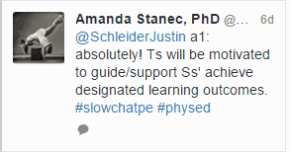
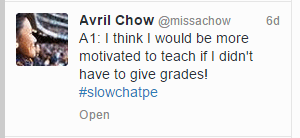
Reflection: This week we discussed grades. The first wonderful surprise I found out was that teachers would be more motivated to teach without grades than less! That is quite the thought provoking epiphany. Does grading students actually hold teachers back?

2014-12-21_1959_0012014-12-21_1959

2014-12-21_2009

My second thought about this week was what do grades tell about the students? Was Brian Jones correct in his tweet? I don’t think that grades are just about college admission. I think they show stakeholders how much progress has been made or needs to be made by the student. Do stakeholders understand this?

screen_shot

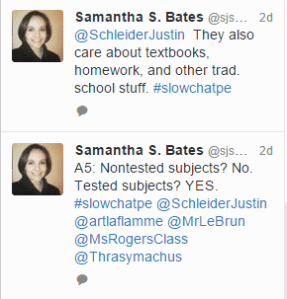
Another point of reflection was brought up by Samantha Bates. Would parents actually care if we just got rid of grades? She seems to think it would only effect tested subject areas. Does this mean non-tested areas don’t matter as much to parents? Are parents like the state and only care about test scores?

The final thoughts on this week’s blog I have is what is my purpose of teaching physical education. To me physical education is more about creating a positive association with movement and physical literacy than it is strictly teaching the curriculum.  Maybe we should put in the grade book a spot for how students feel about physical education at the end of each marking period! I firmly believe it is those who feel that physical literacy is important will be the ones to continue to practice it for the rest of their lives.

What are grades? What do grades tell us? Please read this quick storify of a conversation I had today.  My school went to standards based grading last year.  It was hard for people to understand at first.  My school did an excellent job giving stakeholders the information they needed to understand this change.  They used these two resources Resource 1 and video to help explain this new process. They also met with stakeholders to explain this to them and field any questions they may have had.  The transition was as painless as possible considering they just changed an educational foundation!

@MrZawlocki stated to me that “Grades are not assessments. They are supposed to be communication of learning. Whether single mark or narrative.”  I counter that grades are drawn from assessments.  How can you communicate what has been learned unless you assess? So in my logic (which may be flawed) grades are a representation of assessments.  (he agrees that assessment is needed)

@mssackstein is getting rid of traditional grades this year. This is her video explaining the beginning of her process bit.ly/1yrlQj3.  It will be exciting to see how this goes for her this year. She declared “…grades are…easy for teachers… nothing else. The represent very little.”  I think letter grades represent very little.  Standards based grading represent exactly what education needs.  A clear statement to stakeholders that the student mastered the standard, is working toward the standard, or the standard hasn’t been introduced yet.  “By comparing one child’s performance to a clear standard, parents, students and teachers all know precisely what is expected. Every time a student attempts a task, the performance is compared to the standard, not the other students’ performances.  The most important advantages for students and families are fairness, clarity, and improved learning.” (Douglas B. Reeves, 101 Questions and Answers about Standards, Assessment and Accountability, 2004)

This made think what would happen if we didn’t give out grades at all? Nothing. No letter grades and no standards based grades. Nothing at all. Let’s discuss this week!

Q1 If we didn’t give grades would ts still be motivated to teach? #slowchatpe

Q2 If we didn’t give grades would ss still be motivated to learn? #slowchatpe

Q3 What do grades really mean? #slowchatpe

Q4 Is standards based grading the best method to show student growth? #slowchatpe

Q5 Would parents understand or care if ts stopped giving out grades? #slowchatpe

Increased Test Scores

Fact: standardized testing only tests 1/7 of the whole child.

Fact: standardized testing misses out on the other 6/7 of the child.

Fact: teachers are getting judged based on their student’s ability to improve their test scores.

Fact: standardized testing is here and it isn’t going away any time soon.

This blog is not about whether you agree or disagree about standardized testing.  This is about the fact that standardized testing is here and we have to deal with it until it goes away.  My question is how are you going to attack this problem of needing increased test scores to validate your ability to teach?  What are you going to do to get your students to the next level of testing growth?

Option A is the ground and pound. You teach the kids what will show up on that test.  Every day you pound it into them how to narrow answers down until you get down to the two that makes the most sense.  You teach them that always, never, and sometimes are key words to pay attention to. You have them take a sample test every month so they can really understand and prepare for the test. You make their year’s goal to improve that test score.  If your evaluations are tied to this and money is the carrot that is dangled in front of your face this is what you may choose.  I don’t blame you one bit. Your class will be boring and the students will be extrinsically motivated and forget everything they learned, but I get it.  They set the rules you just play the game.

What if there was a better way that didn’t involve being tedious and boring.  What if there was a simple way to raise test scores that involved no more paperwork for the teacher? No extra assignments for the students to do at home? You wouldn’t have to threaten, cajole, force, push or prod a student to do more work.  All you would have to do is have your students become physically active.

Option B. We all prioritize physical activity and physical literacy as the number one positive change we can make for students.  Let me define all please. Students, teachers, administrators, board members, nurses, custodians, in short any stake holder.  Every stake holder has to share the vision that physical exercise is necessary to student success.  What does physical exercise do? “In one study, for example, nearly 2,000 California schoolchildren who were outside a “healthy fitness zone” — a 12-year-old who took longer than 12 minutes to run a mile would be outside that zone — scored lower on state standardized tests than those who were more fit.” (Adams 2013) That is one example of what research showing exercise alone can increase test scores.

Here is another example. “After adjustment, aerobically fit students had greater odds of passing the NeSA math and reading tests compared with aerobically unfit students regardless of whether the students received free/reduced lunch.” (Rauner 2014) This study shows that socio economic status can be ruled out as the only factor in determining test scores. Physical activity and literacy can make a positive difference! The research goes on and on.  “Being more active, says Singh, may improve blood flow to the brain, which provides more oxygen to cells involved in learning and attention.” (Park 2014) More blood flowing to the brain sounds great! I will take that please.

The why is pretty simple.  “When done regularly, moderate- and vigorous-intensity physical activity strengthens your heart muscle. This improves your heart’s ability to pump blood to your lungs and throughout your body. As a result, more blood flows to your muscles, and oxygen levels in your blood rise.  Capillaries, your body’s tiny blood vessels, also widen. This allows them to deliver more oxygen to your body and carry away waste products.” (NIH 2011) The widened blood vessels combined with a stronger heart allow more oxygen to be available for use in the body.  The more oxygen available the better!

A lowered oxygen level has multiple negative effects.  “It can have a harmful affect on brain function and physical ability. Attention span and concentration may be reduced. Memory and mood can be affected. Abstract reasoning and problem solving skills can be impaired.” (COPD 2009) We want the benefits of increase blood flow.

We can increase student test scores be increasing their physical activity.  This week we will get some ideas of how to increase student’s physical activity in the classroom, the physical education class, and at home.

Q1: How much does your school value physical activity? How can you tell? #slowchatpe

Q2: How do you get them to increase the amount of physically activity in ur class? #slowchatpe

Q3: What can you do to help classroom teachers increase physical activity in the classroom? #slowchatpe

Q4: How do we encourage our students to share our vision of the importance of physical activity at home? #slowchatpe

Q5: What can we do to get community support for physical activity and physical literacy? #slowchatpe

Engaging the non/selective participant

This is something that has been bugging me for at least the last six or seven weeks, as I normally teach at the primary/elementary level, and have had to take on a secondary class this year.

Some of you may have a seen a recent video clip of a teacher physically trying to force a student into the pool during a PE lesson. Whilst one might not understand why this teacher chose to deal with the situation in the way that he did, one of the things questions that came to mind was “had this happened so many times that he had just had enough and was this teacher just driven to the point where he simply blew up?” Nothing excuses the fact that the way in which he dealt with the situation was completely inappropriate. However, perhaps we should consider all factors leading up to the incident to ensure that it never happens again.

As a physical educator, it is tough to even try to understand why someone might choose to exclude him/herself from a PE class. We’ve all heard the excuses.

“I forgot to pack my kit.”

“My kit hasn’t been washed.”

“I don’t feel well.”

The list goes on.

Some reasons students choose not to participate may include lack of motivation, social isolation, PE is not important, competitiveness, lack of support, negative experiences, and discrimination (gender, skills, appearance).

The accepted tradition of excuse notes allowing students to self-exempt from lessons is one such ritual associated with the PE in schools. This policy of excuse notes attributes power to parents and pupils to self-exempt from participating in PE, as parents will provide an excuse note for their child if they do not believe PE holds much value. (Penny Lamb, 2013) I see this happen too often where I currently teach, although we have a policy where students still need to change into their PE kit even if they have a note.

It is our responsibility as physical educators to provide opportunities for students to be physically active. What can we do to ensure all students make the most of these opportunities?

Do share your thoughts.

1) Does this affect you at your current school or do you see it happening in certain year levels?

2) What do you think is the most important factor in motivating students to be physically active?

3) How do you engage your non/selective participant(s)?
4) What is your school’s policy when it comes to parents writing notes to excuse their child from PE lessons?
5) How do you construct an environment that is likely to maximize participation in your lesson?

A Tale of Two Pities

You have to take care of Maslow before you can attempt Bloom

A Tale of Two Pities

I left feeling a little down though.  There were two reasons why.  The first reason is that all these great people (excluding @CapeMay10) work at other schools.  The positivity and vision that where we all worked together to create a great atmosphere was gone. The energy that made the event so worthwhile to go to had evaporated.  The fact remains that when I go back to work (which will be December 1) the same school will be waiting for me that was there before EdcampNJ.  My school is a great place to work but we are still in the process of buying into the vision that I believe is the future of schools.  The idea that technology should be used, that sitting for longer than 15 minutes is unacceptable, that Twitter chats and Voxer are pd that are done willingly because this propels us toward best practices.  The people today are already drinking the Koolaid (strawberry or cherry). They have already “seen the light”. They understand that collaboration and celebration create an atmosphere of positivity and fun.

The second reason I am feeling a little down is that I finally understand what it means to stand up for what you believe in. To go against the grain.  Brian Costello (@btcostello) really hammered home the point when told a tale all too familiar to me about teachers who stop talking when you walk in the room.  It is a lonely place sometimes to stand up and say to your coworkers I am not going along with you anymore. I am going to do what I think is best for my students.  Teachers call you a brown noser because you work alongside administration instead of against them. Who think that because you work hard to cultivate relationships with everyone (parents, students, custodians, secretaries, and teachers) you have an ulterior motive.  During the Schoolburger: The ingredients for better schools (#principalplnBIE Session Notes) one of the presenters stated, “you can be comfortable or you can be brave”.  This is true and it is hard to constantly feel like an outcast.

I understand that we are at a crossroads in education. Every day more teachers are realizing being a connected educator is the only way to reinvigorate a career where we are feeling the squeeze from all sides.  We will reach the tipping point where there will be more connected educators than isolationists.

Part of my problem is that so many of my PLN was there today.  The conversations seemed easy and comfortable.  The discussions were passionate and student based. This is what I crave. People who get me, my sense of humor, and understand under the goofiness I love kids. My PLN are educational leaders who put test scores secondary and a growth mindset first. I am invigorated from a day of learning and increased camaraderie while simultaneously saddened by the realization that we still have such a long way to go.

Q1: How do you keep your PLN small enough to have personal contact but large enough to learn?

Q2: Do you ever feel isolated at work because of your views? How do you overcome that feeling?

Q3: How do convince your peers to buy into connected educator vision?

Q4: Does your school’s mission coincide with your personal school vision? What do you do if it doesn’t?

Q5: How do you rope parents into your vision for their children?

If You Are Positive I Am “Attracted” To You!

Teaching is a profession that has been getting hammered across the country.  Teachers get paid too much, our health care costs too much, BOEs don’t want to give out raises, we don’t work summers, some are mean, some are scary, some have warts, and some are hairy.  You have felt the crunch of the Common Core (which I agree with), new math programs, new reading programs, and the mother lode of overwhelming, technology.  There is no wonder that teachers are feeling negative about the profession.

I am hear to tell you to stop.  Stop whining, crying, lambasting the community, your co workers, the administration, the school, the state, the governor, and the country.  Negativity begets negativity.  We are in the greatest profession in the world!  We teach children.  Children who need us to lead them across the path of life.  To model good decision making, citizenship, and caring.  They may not show it but they need us.

They need us to be positive.  To smile, laugh, and engage them.  They need us to be the constant in their life that will be there for them.  Their lives are a mess. Divorce, awkwardness, sports, grades, dating, money, drugs, alcohol, coolness, hormones, and so much more effect them on a deeper level than they ever let on to.  If anyone has ever taken Handle With Care you know that when one party is unstable the other party has to be the rock.  The unflappable source that exudes a calm and pacificity.

How do I keep this aura of positivity in a world that keeps pulling me down? I surround myself with positive people.  If negativity begets negativity the polar opposite is true as well.  (sorry for the weak pun!)  This is why I have limited my PLN to people who are like minded.  Twitter and Voxer play giant roles in this.  A third way I will be increasing my positivity is by going to @edcampNJ.  This is a gathering that my PLN will be heavily represented at.  The atmosphere will be fun and electric.  I will recharge my batteries by seeing how other educators and leaders act and feel.

People feed off of other people.  If you notice you are being negative make conscious choices to change that.  Remind yourself why you were drawn to teaching, read the Holstee Manifesto, and stop hanging around the complainers.  Find people who have the same outlook as you but don’t just agree with you.  Become the dumbest person in a room full of smart people! That will make you realize how much more to learn there is in the world.  Create something with someone. Contribute to the world of education!

I vow to never let the outside pressures of parents, government, leaders and everyone else who makes my life more difficult to get me down.  For every one of those there are 50 children who I can show a productive path towards their goals.  Students who need me to be silly, goofy, weird, loud, open, caring, and fun.  Students who know when I reprimand them I am upset at their behavior and not with them as a person.

They want to know I will be a constant in our relationship.  It is not a friendship but something a whole lot more important.  We are their teachers!

Q1: Are you a positive person in your educational setting? How do you know?

Q2: Do you make a conscious decision about your outlook on life or does it just occur?

Q3: Do the ss/staff pick up on when you are in bad mood?

Q4: How do you decide who to spend your “free” time with inside and outside of work?

Q5: How do you unwind or relax? How do you “forget” school or education?

Twitter ignited my passion, Voxer stole my heart!

When I blog I like to use the world as my muse.  This year I have become one of those “vaunted” connected educators.  Twitter has been mastered. Chats are easily navigated and I can tell who is on the stay connected bandwagon or the down with testing breed.  There is no argument that both those groups are right; however, I have heard it all before.  Sure Twitter is great for getting links to articles, giving out props to people that are doing great things, and discussing the past, current, and future trends of education.  I want more! The time for just talking in 140 characters is over for me.  I have found the next greatest social media.  That social media is Voxer.  Voxer is a San Francisco based mobile app that allows users to leave voice or text messages and pictures for individuals or groups with the push of a button.  (read Tammy’s blog if you want to learn more: Tammy Neil’s blog )

Voxer is like Twitter’s younger brother that watched it play sports and take on life.  It studied everything its brother did and decided that he was going to learn from his older sibling.  #SatchatVoxer is the first example of this.  #Satchat is one of the most respected Twitter chats out there.  It is run by  Brad Currie (@bradmcurrie), Billy Krakower (@wkrakower), and Scott Rocco (@scottrocco).  It occurs every Saturday morning at 7:30 EST.  They do the best job of getting educational leaders to come and discuss relevant topics in education.  This is evidenced by the fact that they have to moderate #satchat using Twubs to slow the chat down! There are so many people that it’s impossible to read the responses before they disappear from the screen!!

They started #satchatvoxer which was a direct offshoot from #satchat. It took those same #satchat questions and spread them out one a day during the week.  Suddenly there was a whole day to discuss the question.  There were no limits as to how many letters or characters you could type.  Educators were able to have in depth conversations about the question. A dialogue or debate could be started.  The light went off in my head. Voxer had just found itself a special place in my heart.  This group of people love education and are always pushing themselves and others to really analyze their roles as well as others in education.

This would be enough for me if the story ended there.  A great social networking app that appeals to lots of educators where they can hear themselves talk. Yay!  But that is only the tip of the iceberg.  The second metamorphosis of Voxer occurred for me when I was put in VoxerEduMatch.  Here I was surrounded by tech coaches, teachers, and administrators who love education.  More importantly they have a thirst for life. Subjects are brought up and dismissed with the most expediency and randomness one could imagine.  People ask for help and there are always others there to jump in and assist.  This group has become my sounding board where I don’t have to worry about censoring myself.  Thoughts come out are discussed, taken in different directions, or argued against.  It is almost like sitting around a campfire talking education with friends and family.

This would be enough for me if the story ended there.  However, I want more from my PLN.  Talking is great but that is still not doing.  This is where my Osama Abujafar (@osama13) helped create #physedME Voxer group.  Physical educators from Asia, Europe, North America, and I don’t know where else, come together to discuss physical education.  They talk about best practices, great lessons, how to utilize technology and a whole lot more.  They meet once a month for Google hangouts and teach each other and the world the newest technology to use in physical education.  I found a group whose whole goal was action.  They weren’t talking they were doing!  My passion for education was being ignited higher than it has ever been before!

This would be enough for me if the story ended there. The final suture that stitched Voxer to my heart was when I met Nick Endlich (@NicholasEndlich) and Adam Llevo @MrAdamPE.  These gentleman were ready to synthesize! They were ready to create new and better ways to teach Physical Education to the masses. Talking was great undertaking is better. We created our first project entitled #soyouthinkyoucanbalance.  This project was created solely by collaborating on Voxer.  It used Twitter to push out pictures, results, and brought it to the masses.  Voxer was the catalyst though.  Voxer allowed voice messages to be instantly transported across state lines, and continents so that we could work together seamlessly to create something new and original. The sheer amazement of that still leaves me in awe right now.  The push of a button can instantly leave my voice, pic, or text to anyone in the world for free!

This is the first of hopefully many projects that will come from use of Voxer.  I still love Twitter and think it holds immense value for educators; however, it has its limitations when it comes to communication.  Voxer fosters such a personal touch that can only be achieved by hearing someone’s voice.

Q1: Why are you, or aren’t you, on voxer?

Q2: What makes Voxer different than Twitter for you? (good or bad)

Q3: How have you used social media to better your role in education?

Q4: How do you see social media changing in the next 5-10 years?

Q5: How can we get our ss to embrace educational social media?

Student Voice in Physical Education

Do your students have a voice in your class?

For years I would stand up in front of my classes telling them exactly what they were going to to do and when, never giving any consideration as to whether it was of any interest to them.  After all, I’m the teacher and I know best, right???  Until about 2 years ago when my current teaching environment changed.  I went from teaching K-4 to teaching K-6, which was a welcomed change, but one I wasn’t quite prepared for.

After struggling to engage my 6th grade students in my lessons I realized I needed to make some changes.  And almost out of desperation I asked my students what they were interested in.  I used a quick Socrative survey to ask my students what units/activities they were interested in participating in.  So I used the data that they provided and started to plan my future lessons.  For the remainder of that year I would offer 2-3 different activities for the students to participate in.  All activities were aligned with the standards, curriculum and objectives.  As I reflected on my teaching I realized that my students had a greater insight into their learning than I ever gave them credit for.  To this day I continue to collect data, now through Google Forms, as to their interests and plan my lessons based upon this data.  This “ah-ha” moment opened my eyes to a new way to approach teaching.  Ever since, I’ve made a conscious effort to utilize my student’s ideas, interests, and abilities to develop more meaningful lessons and activities that promote a more engaged learning environment.

Don’t get me wrong, I’m still the “teacher”, but my role is more of facilitator.  I allow my students to display their understanding and knowledge of concepts and skills in multiple ways.  This may be as simple of giving them the option to work individually, with a partner or in a small group.  I also provide choices for activities/games, allowing students to choose an activity based upon their perceived ability, not mine.  We must meet our students individual learning styles by providing them the optimal opportunity for learning and who better to know what that is than our students.  I challenge you to examine your teaching style and ask yourself this question:  Do my students have a voice in their learning?  When you provide opportunities for your students to be heard, it’s amazing as to what you (the teacher) can learn!

Below are this weeks questions, thanks for sharing your thoughts!

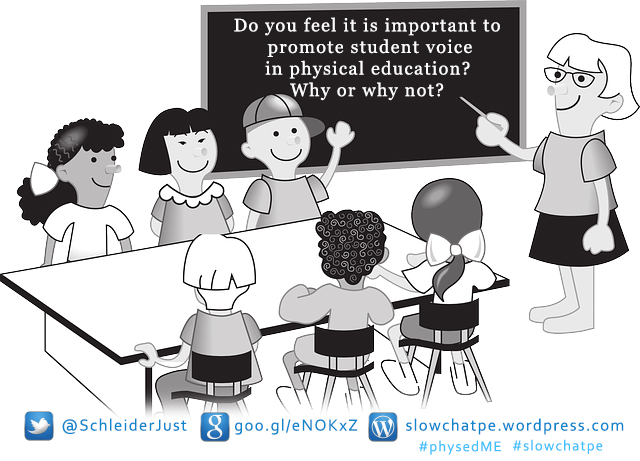
1- Do you feel it is important to promote student voice in physical education? Why or why not?

school-teacher-148135_640

2- In what ways do you promote student voice in your classes?

in wgat

3- What benefits can student voice provide our classes and student learning?

what

4- What barriers/challenges do you see in incorporating student voice into your classes?

barrrr

5 – What tools, activities, and strategies do/can you utilize that promote student voice?

tools

Assessments in Education

 “Assessment is the process of gathering and discussing information from multiple and diverse sources in order to develop a deep understanding of what students know, understand, and can do with their knowledge as a result of their educational experiences; the process culminates when assessment results are used to improve subsequent learning.”  (Learner-Centered Assessment on College Campuses: shifting the focus from teaching to learning by Huba and Freed 2000).

The first thought that pops into my head when we talk about assessing our students is standardized testing.  There should be no argument that standardized testing does not show the full learning and understanding that occurs throughout the year.  The Onion, a satirical website, has a video and an article that hammers home why standardized testing is less than stellar when assessing our students. (video has foul language) Standardized testing is only one kind of summative assessment.   There are many other ways to assess students without having them fill in bubbles for three hours at a clip.

Another major problem with summative assessments are that they only show what you learned, or didn’t learn, at the end of the unit or year.  It is too late in most cases to have the students learn or relearn the material after the year or unit.  However, they do show if the standard has been met which is one purpose of teaching.  We need summative assessments, just not standardized testing as the only summative assessments to assess our students.

The other type of assessments are formative assessments. These are the assessments that can change the way students learn.  They find out where the students are during the unit and help them either catch up or propel them forward to the next lesson.  Formative assessments can be quick hitters or more in depth.  The point of them is to find out are the students where they should be during the unit and where should they go from there.

Both assessments are needed to make sure the students are understanding, and can demonstrate the standards.  The job of the teacher is to make these assessments fun and exciting while still collecting the data needed to identify the needs of the class. My hope is that this week we will hear about assessments that are engaging to the students as well as interesting to the students.

Q1. What technology do you use to help you assess students?

4137633043_f5ee7a0073

Q2. What assessment do you use that does not need any technology?

adult-15700_1920

Q3.  How much do assessments factor into modifying your units?

Alliance_Française_de_Moldavie_-_Cours_de_français-1

Q4.  How does standardized testing effect your teaching or observations?

Exam

Q5.  Is it possible for formative assessments to tell if the students have met the standards? Why or why not?

Untitled-2

Q6.  How do you keep abreast of the new assessment tools that are constantly being introduced?

google-76517

Gender Equality in PE

Reflection

The most important, and overlooked, part of teaching is reflecting.  It is a step that requires time, a growth mindset, and the ability to look at an event with clarity and objectiveness.  This week was the first week of #slowchatpe.  I decided to come out of the box swinging and discuss the object of gender equality in Physical Education.  My heart was in the right place but my execution was lacking.  The questions did not elicit the passionate responses I was hoping for. In some cases the questions had the opposite effect of what I had intended.  It was the first time that I ever thought that I had made a huge mistake.   The professional learning community I was striving to impress and fit in with did not seem enthralled with my angle on things.  I wondered whether I lost the respect of some of these people.  Did they think I was some kind of Neanderthal who thinks that men are superior to women?  It bothered me so much that I went back and changed one of my questions after I posted it because the reaction I received made me feel so down.

I have to accept responsibility for the fact that I tackled a hard subject and did not put enough thought into the questions I was going to pose.  They made sense to me but fell flat when people did not read my blog and understand where I was coming from.  If we approach every opportunity as a learning one, than I need to learn from this. I have come up with a system where I write the questions and then have someone else read them and give me feedback before I post them.  Another change that needs to be made is that the questions should be written a couple days prior to the post.  This way I could reword the questions after I have some fresh perspective and feedback from my peers.  I apologize to any professionals who feel that I didn’t approach this with the reverence and respect the subject deserved.  I will fail forward just like I expect my students to!

This week was not all negatives though.  @mrlebrun had a great point this week:

Ross LeBrun @MrLeBrun

1024px-Bathroom-gender-sign

A5: Don’t know this is an education Q. We can model gender equality all we want. Society needs to have some major shifts. #slowchatpe

Cassie Brooks shared one of her best practices with this tweet:

Cassie Brooks @Brooks01CL

@SchleiderJustin A2 Have coed w many girls more athletic. Like 2 offer choice of competition level not single-gender games #slowchatPE

Cassie is right. It is not about gender but physical literacy.  It is about our students learning skills that they will use throughout their lives.  It is not about the game but how the games refine their skills.  It is not about how fast you are. It is about how you can improve your physical skills to maintain wellness.

I felt this week was a success;  however, it was not the home-run that I was hoping for.  My purpose was to show that gender should never be a factor in what or how we teach.  Gender doesn’t make any difference.  What matters is the mindset of the student, the content presented to them, and the teacher removing any gender bias from their pedagogy.

Original Post

I like to discuss the things that resonate with me.  Twice in the past weeks there have been discussions about gender equality in schools.  The first discussion revolved around whether girls and boys should have equal rules in school.  (#totallyrossome)  I took the literal approach and stated that boys and girls have to go different bathrooms.  That right there shows that there are different rules for boys and girls.  As asinine as that statement appears on the surface students do know the difference between girls and boys as early as kindergarten.  I am not arguing if it is taught to them through societal values and norms or whether they naturally sense things are different between the sexes.  Bathrooms are the earliest knowledge taught to the students about gender differences.

The part of the conversation that made me question gender equality was when someone asked was it different for a boy verse girl fight than and a boy verse boy fight?  Immediately the answer was apparent to me.  In my opinion a typical boy verses a typical girl would be a physical mismatch in favor of the boy.  That statement opened a heated discussion with @SJBates as well as @mmecushmore. They challenged my assumption was wrong.

My counter to that argument was that every record in the Olympics is owned by men.  Before you attack me I go and research the dumb things that I say after they come out of my mouth. (I realize that is not the best approach but either way I am still learning.)  I was wrong. I found out that, “The equestrian events are the only Olympic sport where men and women compete against each other on equal terms. At the 2004 Olympics in Sydney, Australia, women captured the gold, silver and bronze awards in the individual event category, a four-day contest involving cross country, dressage and show jumping that until 1952 was only open to military men.” http://goo.gl/nJ4w9l

This was only one Olympic event though and the physical output was done more by the horse than by the rider.  In every other event men are objectively faster or stronger.  My mind was still set that men were physically superior to women.  The next moment I came across a statement that put a crack in my gender philosophical foundation.   Eileen McDonagh, author of Playing With the Big Boys, dropped this mind bomb, “These things, to some degree, are self-fulfilling prophecies,” she says. It does hurt women to exclude them. Just the process of discrimination stigmatizes women as inferior.” This immediately brought about thoughts of Roger Bannister’s historic dismantling of the thoughts that no human could break the sub four minute mile record.  As soon as he broke the record it became commonplace among athletes.  No woman has ever broke the 4 minute mile.  Is psychology playing a part in this?

Our heated discussion took a wild turn when I was told females were not in professional sports solely due to gender.  This blew my mind! If a woman could throw a hundred mile per hour fastball she would be a starter on the Yankees.  Whenever I search for answers I attempt to find experts and ask them questions.  In this scenario my expert was Dr. Amanda Stanec. (@movelivelearn)  She definitely thinks that female hockey goalies could compete at the same level as men.  My brain was being challenged and wouldn’t let this issue rest. Could I be wrong? Are males only superior due to societal norms?

The final thought that sent me over the edge was when I saw this photo on twitter. On the list of dos and don’ts are some great ideas. Physical education teachers should not “girl pushups” or segregate teams based on girls against boys.  I am all about having girls demonstrate skills that may have been thought of as male dominated. (pushups, pull-ups, throwing a football etc.)  What really got me thinking was when the list included saying ladies and gentleman or calling the defensive position of first base a first basemen under the don’t column.  It reminded me of the George Carlin standup when he asked where does it end? Do we call manhole covers people hole covers, or David Letterman David Letterperson?  Does the gender gap that I see exist because of what adults present as norms to females?  Why is it ok for girls to be on boys teams but not vice versa if we are really worried about gender equality? These are questions that are really starting to bother me.

I have a daughter that is two years old.  I want her to feel that she is being raised in a house of yes. A house where the only obstacles to doing what you want are safety and planning. She shouldn’t feel that gender would hold her back from anything.  What worries me is that I may be unconsciously stifling her ability to choose based on my thinking and actions.  Will telling her go be the first basemen make her think that only boys can play first base? If she is called lady will that make her feel inferior to my son?

This week I would like to engage in an open and honest dialogue about gender equality.  The questions below that will be posted daily on #slowchatPE.  #slowchatPE is a new hashtag where moderators will present a subject a week that pertains to physical education.  Each day a new question will be posted and people from all over the world can interact and discuss best practices for students.

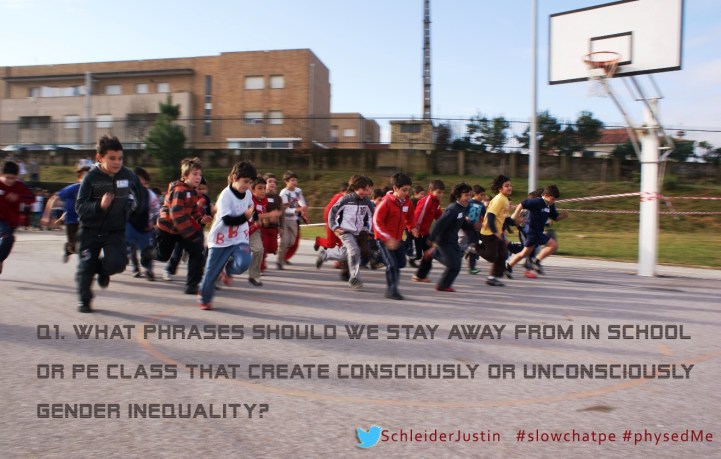
Q1. What phrases should we stay away from in school or PE class that create consciously or unconsciously gender inequality?
SONY DSC

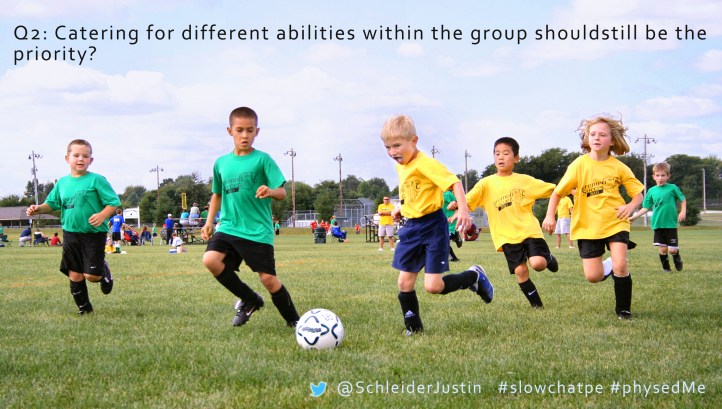
Q2. Is segregation of gender in physical education classes furthering the gender stereotypes?
Youth-soccer-indiana

Q3. Why do you think there has not been a female that has broken the 4 minute mile?

4282512590_635aaf2d96_z

Q4.  Are there any areas where females are physically superior to men? Does that send the wrong message to males?

Boxing_in_Uruguay_-_Palacio_Peñarol

Q5. How far left do we have to go in education for gender equality?

1024px-Bathroom-gender-sign