Restorative Justice in Education

I am not insane. This means that I can’t keep doing the same thing and expecting different results. “Punishment is used to help decrease the probability that a specific undesired behavior will occur with the delivery of a consequence immediately after the undesired response/behavior is exhibited.” (link) This isn’t working. Some of our students are still exhibiting that undesirable behavior. We keep punishing our students for their behavior even though it hasn’t changed it. This means that the consequences aren’t doing their intended jobs. How can we change this?

One of the ways to change this is to look at using restorative justice in our classes and schools.

Restorative justice (RJ) is a powerful approach to discipline that focuses on repairing harm through inclusive processes that engage all stakeholders. Implemented well, RJ shifts the focus of discipline from punishment to learning and from the individual to the community. However, it is often misperceived and misapplied. (link)

What a fantastic idea! Have the students repair the harm that their decisions caused. Right now our education system looks very similar to the prison system. If you make a decision you get penalized. Too many poor decisions and you are removed from your surroundings. This system is not working. It isn’t working for society and it isn’t working for education.

You may be asking yourself how this looks. I would recommend watching this interview I did With Victor Small Jr. and Jerod Phillips. This padlet was created by Victor and the Restorative Justice Voxer group. If you want to join the Voxer group click this link. One of the main ideas of Restorative Justice is the use of circles.

When we sit in a circle we experience a stronger sense of community. Every person in the circle shares responsibility for its functioning. Circle culture is more “yes-and” than “either-or.” Yes, there is a leader, and each person takes the lead in turn, each time it is their turn to speak. Yes, some guidelines are given and the group makes its own agreements. Decisions are made, but by consensus of the whole group, and sometimes this means decisions come slowly or take unexpected forms. Thus, one of the main purposes of circle dialogue is building community. Another purpose is supporting the kinds of honest, authentic dialogue that is necessary to effectively respond to challenging behavior and circumstances. These two intentions for circles take shape as two different types of circle: community building and responsive. A premise that runs throughout this manual is that responsive circles (for responding to misbehavior and harm) work best in classrooms where a foundation has been developed through community building circles.

There is a lot to unpack when it comes to Restorative Justice.  It is an alternative to quick and uncaring suspensions and penalties that simply don’t work. If you want to engage in a conversation about RJ come join the slowchatpe voxer group this week while we discuss the pros and cons and work our way through this new way to solve disputes and create a climate where students don’t fear the teacher while simultaneously learning how to deal with conflict in a way that will benefit them in the long-term as well as the present.


Disallow

Last year my one word was fear. I was worried about the direction the country was heading and my fear came to fruition. You can read why here. This year I am choosing DISALLOW as my one word. The number one reason I am choosing that word is that someone needs to stand up when they see things that go against what they stand for.

All too often on social media, people get bent out of shape when others disagree with them. I disallow the fact that people may not like me to stand in the way of bettering myself and my profession. I can always improve how I go about discussing what I see to make sure people understand I am not attacking them personally. There will be a much deeper blog about this in the future.

I disallow myself to normalize the tragic events that are occurring here in America as well as all over the world. It is impossible to keep my head in the sand any longer. I will continue to keep myself in tune with what is happening in the world. Unfortunately for some of my PLN this means that you will be seeing tweets about Aleppo as well as my social media posts reminding you that Flint Michigan still doesn’t have clean water.

Most importantly 2017 will not be there that I disallow myself from becoming complacent. This means that I will continue to improve my wellness. Over the break, I created a workout room in my living room to increase my physical wellness. Spiritually I have dabbled in yoga (for 10 minutes) and will continue to work on mindfulness. My intellectual wellness will be challenged again when I write my next chapter for the second Edumatch book. You can purchase the first Edumatch book from Amazon here or you can get a copy of the free e-book here. I encourage you to read the free version and send it to your friends. 

My one word is not about resolutions. It is about continuing to push myself to new heights by disallowing stagnation, complacency, or roadblocks to keep me from being the best version of myself I can be.

Pretty Privilege

Here is another anonymous blog post sent to me that I would like to post and respond to.

This all boils down to something I will call pretty privilege.  Pretty privilege is subtle, not as in your face as other types of privilege.  I will say that I think I have a pretty face, and am attractive from the neck up (as long as you don’t count my hair…#workinprogress), but I don’t usually have pretty privilege.

The idea of pretty privilege is stupid.  There are way more important things to worry about, even more pressing inequalities in the world.  But since this is on my mind, I will write about it.

I haven’t invested as much into my wardrobe or other things you see many women doing, because I thought I was wasting my time.  Who am I getting dolled up for?  Oh right, nobody, because I’m invisible.  So why waste all this time and money?  Turns out guys want these things, so it’s a cycle.

Pretty privilege is not just about dating.  Life does not revolve around having a man…trust me, I would know.  But pretty privilege is also about people treating you like a human being, instead of just some…thing.  There are way too many examples to share here, but you can definitely see the difference.  There are so many variables that could be at play, but pretty privilege (among other things) is what I think of first.


In order to get pretty privilege, you need the total package. Pretty privilege is the combination of good looks, a nice body, nice clothes, and charm. You probably need at least 3 of the 4.  I usually have one or two going for me at any given time. Yes, I can be charming at times, and I’m getting a little better in this area, but I’m still extremely awkward.

Even when I had a “nice body” for a hot second, my dating life was worse than ever because I still was holding onto that emotional baggage. I was bitter then because I put in all that hard work (it was REALLY hard) and guys still weren’t falling at my feet.

Nobody wants a bag lady.

The world cares a lot about pretty privilege, but probably not as much as I think. It’s ridiculous how shallow I am. I realize that the maturity level of some, maybe most, people has surpassed mine in this area.  But I’ll be stuck here until I work it out.  This is me trying to work it out.  Maybe in 2017 I can work on not caring so much which will no doubt lead to more happiness.

This post was both poignant and heartbreaking. I too do not feel that I am a “pretty” individual. I would classify myself as average at best. This is one of the reasons that I do not care much about how I am dressed. Why does it matter what clothes I am wearing when I have a gigantic nose that people will be focused on anyway. With the realistic understanding that I am not part of the beautiful crowd, I have been freed from worrying about my looks. This is mostly liberating.

One reason why I am able to not dwell on this and let it take over as much as my guest blogger is because I am a male. Males have the ability to shrug looks off and can focus on their other strengths. An example of this is the funny guys, the sports guys, or the musicians. In my opinion, looks do not drive males self-worth as much as it seems it does for females. This is because we see males who most would not consider part of the beautiful crowd with women who we would. Just look at Everybody Loves Raymond, King of Queens, or Modern Family. Males can play to their other strengths and be accepted. It doesn’t seem like women have that same opportunity. I would imagine that those individuals who identify outside of male or female struggle with this as much or more than the guest blogger.

This would not matter as much if it was just about finding a mate. As you read in the guest blog above looks affect your self-worth. If you believe that people see you in a negative light it changes the decisions you make. You may not want to go to that new situation where you don’t know a lot of people. If you do go to these events and you are not comfortable in your skin you will not be as apt to be social and make those networking connections that are so important both personally and professionally.

Looks affect our income. Take this article for example:

Harvard economist Markus Mobius and Wesleyan University economist Tanya Rosenblat published the seminal paper “Why Beauty Matters” in 1994. They found that in three different samples of workers, more attractive people consistently earned 12 to 14 percent more than unattractive people — regardless of gender — with evidence that the “labor market sorts the best-looking people into occupations where their looks are productive.”

To that end, a 2012 paper found that comely real estate brokers outperformed homely colleagues. (link)

What worries me the most is looks affect our students’ education. This comes from both students and teachers.

More uncomfortably, first- and sixth-graders think attractive teachers are kinder and happier, and college students thought that attractive professors were clearer, more helpful, and of higher overall quality.

In news to no one who was awkward in high school (or beyond), hot people tend to be super confident. Mobius and Rosenblat chalk this up to a self-fulfilling prophecy that will have been at work since kindergarten — teachers expect cute kids to do well (thanks to above-mentioned halo effect), so they give them more attention than ugly kids. With that attention comes better grades, more confidence, and greater comfort with public display. (link)

My final thought is that school shouldn’t be where “pretty privilege” begins to sprout. This means that we have to address this head on. When a student comes in looking so cute we dote on them just as much, not more, as when they get that lightbulb moment in class. We as educators should recognize that we have a bias towards our student’s looks. What we judge as cute is influenced by race, weight, or other physical features that students have no control over. Let’s be aware next time a student breaks a rule on how we handle the situation. Did we excuse their behavior because they are so cute? Did their looks (weight, gender, race) have anything to do with why we doled out consequences? Are we being fair when it comes to the rules in our class? (In this case fairness being more about equality than equity.) This is an area that I will be working to improve.

NFL and Dodgeball

Physical Education as a whole has a confidence problem. We are constantly worried about our brand. Don’t call us gym teachers because we don’t teach gym. Make sure you dress up so people won’t think X Y or Z about you. Let’s latch onto the term physical literacy because it legitimizes us as teachers. After all, if other teachers teach numeracy and literacy we will fit right in! Dodgeball is the devil! Not only should students not play it in class no one anywhere should play it! We feel inferior to everyone. I understand it completely. When people ask me what do I do I tell them I teach Physical Education and I cringe. I imagine what these people who may or may not be in education are thinking. I follow my job title up with a quick elevator speech of what a Quality Physical Education program look like. 


2016-12-18_0044.pngThe reason that I bring up all this up is that the NFL is having a dodgeball competition played by the professional players during the pro bowl. The audacity of them! The unmitigated gall! How could the NFL who supports physical education through the
Fuel up to Play 60 program do this to us? SHAPE America has an official position against it after all! Don’t they understand how much we have been stigmatized by that game? That game has single handily brought down the reputation of our noble profession. When people play that game a Physical Education teacher loses their whistle.

Let’s dissect the NFL and their affiliation with SHAPE America and physical education in general. Fuel Up to Play 60 is an in-school nutrition and physical activity program launched by National Dairy Council and NFL, in collaboration with the USDA, to help encourage today’s youth to lead healthier lives. Physical Education and Health educators can apply for grants of $4,000 is available per school year to support teachers and their students as they work to implement Plays from the Fuel Up to Play 60 Playbook. They also provide wellness activities that are part of this program are based on best practices and encourage students to take a leadership role. Fuel Up to Play 60 is for every student, and there are ways for them to get involved in their own wellness — online and offline — every day of the year. We can safely say that the NFL and physical education have a great relationship. 

Now let’s look at some big stories that have recently come from the NFL. We have multiple players arrested for domestic violence. That is a nice way of saying that grown men who are physically at their peak brutally assault women who cannot protect themselves.

The book, “League of Denial: The NFL, Concussions and the Battle for Truth,” reports that the NFL used its power and resources to discredit independent scientists and their work; that the league cited research data that minimized the dangers of concussions while emphasizing the league’s own flawed research; and that league executives employed an aggressive public relations strategy designed to keep the public unaware of what league executives really knew about the effects of playing the game.

Read that again. The NFL covered up the effects that concussions had on their players. Do you think that this didn’t affect high school players as well? Don’t you think they were suffering concussions when they were playing as well?

As SHAPE America members are we more worried about grown men playing dodgeball outside of a physical education class than what the NFL actually stands for? Where was this worry and outrage when we were accepting support from a league that employed physical abusers and covered up the destruction of their employees? No one said anything then. Suddenly play some dodgeball during pro bowl weekend and we care. We are outraged that an activity that has a high mvpa rate and is clearly a game that will increase a person’s physical literacy, would be held by an organization that supports SHAPE America.

Dodgeball is a fantastic game that should be played outside of physical education class. It should be encouraged for anyone who is not fearful of getting hit in the face to play. We do not play it in class due to the fact that it creates an imbalance of power and some students have the RIGHTFUL fear of getting hit in the face. People will get hit in the face when they play. If you understand this may happen and you willingly take that risk the game is a fantastic calorie burner.  

If we as a profession are worried about how we are perceived, start to create a Quality Physical Education program. Allow parents and stakeholders to see what you are doing in your class. Volunteer to be on school committees to show your dedication as well as how much of an asset you are to the team. If you want to make real changes don’t petition the NFL, join your state AHPERD or SHAPE. Dodgeball is not the problem. We ARE THE PROBLEM.

We have to be advocates for our program. We have to take on the team of teachers that we work with that are simply rolling out the ball. We have to start finding professional development outside of school hours to better ourselves. We have to show that we are more than just sports. We are the only subject that can teach the whole child. Grown adults playing dodgeball at a half time does not worry me. What worries me is the people posting videos on Twitter or Facebook that don’t tie into the standards. What worries me is a physical education teacher not being able to articulate why we won’t play dodgeball in our class to their students. What worries me is the policing of activities outside of our class because we are worried about how it makes our profession look. What worries me is that we are a profession that is twisting in the wind unsure of our identity.


Another vantage point: Watch Your Mouth! — Dr. Dorian Leigh Roberts

There are a couple of things that you won’t catch me doing. You won’t catch me eating fried chicken out in public. You won’t catch me eating watermelon out in public. You won’t catch me teaching students that the button on the iPad is called the “belly button.” You won’t catch me cussing in front […]

via Watch Your Mouth! — Dr. Dorian Leigh Roberts

The n-word

What would you do if you heard a student call another student the n-word in a cavalier and friendly manner? What would you do if a student called  you the n-word? I would imagine the tone of the child, the color of the child, and the color of your skin would play major factors into your response. The reason this is even a subject that I am writing about is that I was in a public Voxer group last week and a gentleman who is white used the entire word numerous times repeating what a student allegedly called him as well as their friends. 

I side voxed the person and told them that although I was not personally offended by the word I did not think it was a poor idea for them to say it. Every adult in America knows what word someone is referring to. It does not need to be used in its entirety. I personally thought they overstepped their bounds by using it. This person was open to my dialogue but ultimately disregarded my words.

I discussed this story with a friend of mine who is black and they asked me why I was not offended by the word. This forced me to figure out why I wasn’t offended? I know the word has a steep history of hate and violence behind it. I consider myself a humanitarian. Why am I not offended personally by its use? I came to the conclusion that the word has no power over me directly and that is why it didn’t offend me.

I also realized that on some level I should be offended by it because it hurts people I care about. This was an awareness that grew because I was challenged.

This brings us back to the original reason why the word was brought up in the Voxer group. What would you do if your students were using the n-word to each other and neither party was offended by it? I listened to numerous black people speak up about what they would do as well as what they have done in the past. They were all in agreement that the word in any form should not have a place in school.

How would I react if one of my students called me, a white male, that in school? I don’t know.

I have a couple of major takeaways from this exchange over the last week. The first one is that anyone who is not black should not be using the word in any form. Secondly, it is about the students comfort more than my own. Lastly, if you do hear the word it is a great time to grab that teachable moment. Ask the students do you know the history of the word? Does it make any of the other students uncomfortable when they use it? Why do they feel the need to use it? This could be the start of a great discussion and gain an insight into our student’s lives.

13th Amendment

The climate on social media has changed. The bridge that allies had been building over the past couple of years were suddenly torn down as if a hurricane had swept through. It was allies fault that the election went the way it did. We didn’t have the conversations with our families and friends that would have turned the tide. We didn’t campaign hard enough, shout loud enough, entice enough voters to come out and support the marginalized people of the United States. Allies did a lot of talking but were there enough action?

One of the messages that I have seen over and over again is that it is not the job of the downtrodden to teach the privileged. Where does that leave people like myself? How am I going to learn when the source of the pain and suffering is tired of speaking about it? The same way everyone else in the world learns anything. Read a book, go online, or watch a factual documentary that will explain the history of the United States and how it was built on the backs of blacks. So that is what I did. I watched the 13th Amendment on Netflix and live tweeted it because the message is so important.

I must be honest. This is not a movie for the faint of heart.  It started with this stat. The United States have 5% of the world’s population and houses 25% of the world’s prisoners. That stat alone should raise your eyebrow. In 1970 there were 340,000 people in prison. In 2015 there are 2.3 million prisoners. That is an extraordinary jump. We have 737 people in jail for every 100,000 residents. One million of the 2.3 million people locked up are black. It doesn’t make sense that a group of people that makes up 17% of the population makes up almost half of the people incarcerated. How is this the land of the free when we have so many people incarcerated? The movie helps explain the history behind this.

The 13th amendment states:
Section 1. Neither slavery nor involuntary servitude, except as a punishment for crime whereof the party shall have been duly convicted, shall exist within the United States, or any place subject to their jurisdiction.

The important part of this amendment is that slavery/involuntary servitude was illegal unless that person was convicted of a crime. This “loophole” created a climate where people of color were arrested for,  “…minor crimes such as unemployment, loitering or gambling, and selling them to private employers through the convict lease system.” Once they were thrown in jail they were free labor for the South to rebuild itself. America was literally built on the backs of jailed People of Color.

I had no idea what the movie Birth of a Nation (the original)  was about let alone it being the most racist mainstream movie ever made. This movies creation created reverberations that are still being heard today.

What makes “Birth’’ most offensive is its depiction of its black characters — all of the prominent ones performed by white actors in blackface — during Reconstruction. Griffith depicts defeated Southerners being terrorized (and even disenfranchised from voting) by illiterate, corrupt and uncouth former slaves (seeking interracial marriage) under the influence of white Northern carpetbaggers. Link

I did not know that the movie created the burning cross as a symbol for the KKK.

Thomas Dixon included a pivotal cross-burning scene in his 1905 novel The Clansman; he was attempting to legitimize the Klan’s supposed connections to the Scottish clans. A decade later, D.W. Griffith brought The Clansman to the silver screen, eventually renaming it The Birth of a Nation. Exhilarated by Griffith’s sympathetic portrayal, Klansmen started burning crosses soon after to intimidate minorities, Catholics, and anyone else suspected of betraying the order’s ideals. The first reported burning took place in Georgia on Thanksgiving Eve, 1915. They have been associated with racist violence ever since. Link

The visuals from the movie were disturbing. It showed pictures of People of Color hanging from trees as well as images of slaves who were brutally beaten. It also showed pictures of Emmett Till. I had known the story of Emmett previously; however, seeing the video of his mother at the funeral on video brought it to a whole other level. Emmett’s mom had purposefully had an open casket so everyone could see the carnage that was done to him. This is not the history that is taught in schools.

Fast forward to Richard Nixon, Ronald Reagan, and Bill Clinton. Nixon purposefully brainwashed Americans into correlating Hippies and marijuana as well as People of Color and heroin. This was a way to keep control of a population.

Reagan made possession of 5 grams of crack an immediate 5-year mandatory sentence while cocaine, essentially the same drug in a different form, needed 500 grams to receive the same sentence. Crack was used mostly in cities while cocaine was mostly used in the suburbs. Who do you think was affected by this difference in sentencing?

Bill Clinton created the three strikes and you’re out rule. This combined with mandatory sentencing took all the power out of the judge’s hands and placed it instead into the prosecutor’s hands. You can see how as a country we have used the legal system to keep People of Color behind the eight ball.

The most powerful part of the movie is that it shows the number of people being jailed each decade on a line graph. This is coupled with music of that decade. The LA Times states, “…music plays a key role as well, not only with songs like Nina Simone’s version of “Work Song” heard on the sound track, but with key words from rap lyrics like Public Enemy’s “Don’t Believe the Hype” appearing as arresting large type on the screen.” Link We forget that music is a political commentary as well as an artistic endeavor.

When we look at the current climate we see People of Color being shot in the back by police, placed in illegal choke-holds and suffocated, and dying on the way to jail in the custody of police. We still have people driving around with confederate flags on their trucks, people freaking out that the Mall of America hired a black Santa and a President who was supported by the KKK.

I am doing this movie a complete injustice. You need to watch it. I will end this blog with the closing thought of the movie. We ask ourselves how could people tolerate slavery and lynching back in the day? We are living and tolerating it now.


Link

The trimester is quickly coming to a head. This year my main goal was to get back to building relationships with my students. I felt last year I put too much emphasis on the cognitive and psychomotor domain, neglecting the affective domain. I implemented a hugs, high fives, or handshakes policy for my students. They could choose any of the three. My hope was that the physical touch would help break down barriers between myself and my students. I know for me personally I was in a much better mindset after the triple h’s.

It was time for me to judge just how well I was doing toward my goal. I gave my students a quick 5 question survey. The first survey made me quite upset when I saw the results. 1Three students thought that I disliked them. That is horrible. The interesting part is that the students who think this are not the students who take the bulk of my  time and attention. They are quiet and would have the ability to fall through the cracks if my school wasn’t so tiny. They are not students of color. I only mention this because I wanted to know if I was treating my students of color differently than the other students. I will make sure I actively work to create more positive interactions between myself and those students. 

2The responses to question two were interesting. The previous 3 students who thought I disliked them  (submitted a score of 2) rated my class as a 2, 3, and 4. This means that one of those students thought I disliked them but still enjoyed my class. The other two thought my class was OK and poor. I was pleased that over 90% of my students were enjoying my class. Education has lost its way. They do not value fun and enjoyment of learning as much as they should. When educators are able to create positive associations with learning that is success. 

I finished the survey by giving them the ability to choose a dance and the next unit. This is 3.pngone way how  the journey of shared power and student centered classrooms can continue. How often are we really finding out how our students feel about our class? This year we have been using a game based approach that can loosely be considered Teaching Games for Understanding. The overall feedback from the unit was mostly positive. My biggest problem now is to figure out how to create a dance to Juju on That Beat! 


EdcampNJ reflection

“Great job everyone today! Best part for me was seeing everyone get up and check under their chairs for the prizes. Pretty awesome to see 400 people smile all at the same time. Bravo!” This was feedback that we received on Saturday after running EdCampNJ. That person was only referring to how we started the day! It only got better from there.

To give you some quick background, I somehow found my way onto the organizing committee of EdCampNJ. This should surprise you because I am horrible at any organizational task. I jokingly tell people I am a big picture person who doesn’t always worry about the details. Organizing committees are extremely worried about details. West Windsor we have a problem. Luckily I was only given two jobs to do. Get the food and be obnoxious.

Wow! Two things right in my wheelhouse. I went to Caesars Bagels to purchase the greatest bagels on the planet at six thirty in the morning. There is nothing better in the world than his bagels. If you ever come visit we will go and eat there. Done deal. I rolled up to pick up the bagels and he looked at my vehicle and started laughing. He told me there was no way that it was going to fit in my car. Lucky for me, he lent me his minivan so there was plenty of room and time for the bagels to be delivered. 

My second job was handing out prizes on the Prize Patrol. Chrissy Romano and I would bust into rooms swat prize patrol style being as loud and disruptive as possible.  I have to admit I felt like the white Oprah. I was yelling out, “You get a prize and you get a prize” to hundreds of smiling faces. Surprisingly Chrissy was louder and more obnoxious than me!! That was some ridiculous fun. Everyone should get a chance to smile that often. 

Time to get to the education part of the day. I was able to go to one session with Mike Ritzius. As I walked in the door I heard him ask why people were there. I truthfully retorted I was there because of him. I had no idea what his facilitation was about. I didn’t read the title of it. I hold him in such high esteem that if he is talking about anything I will listen. His idea was about what professional development and leadership truly were. It was much too high level for me to begin to fully master in 45 minutes.

He truly did a fantastic job of facilitating. He would explain a concept to us and then we would discuss that concept with our immediate group for 5 minutes. After that time the whole group would talk for 5 minutes.

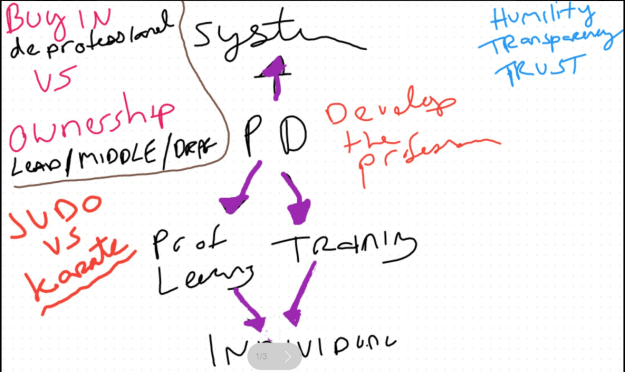
My first big takeaway from his session was that PD should look up at the system and use the strengths of their teachers to drive professional development instead of looking down on teachers from a deficit mindset. (sketch notes via Adam Schoenbart) adam_1.png

My second takeaway was that in between order and chaos lies leadership. We need norms and routines while also allowing autonomy and self-reflection. His visual of management falling in between order and control was brilliant. We did not discuss this, and I may be off base, but we need both leadership and management in our school. We can discuss this more at length in the future. (sketch notes via Adam Schoenbart) 

adam_2_

The final idea we didn’t delve into as much as I would have like to. This was called the Art of Hosting. I have found this link that will help explain the idea more. I am going to follow up with Mike and really delve into these ideas much more. If you would like to contact him his twitter is @mritzius. (sketch notes via Adam Schoenbart)

adam_3_.png

The sessions that were facilitated were amazing! We had people speaking to our students about the election, the lbgtqia community, sketch noting and so much more. The emphasis was not just about some new tech tools that look cool. Social justice was somewhat represented. I did not see any sessions about culturally responsive classrooms. I would hope in the future someone would be comfortable facilitating a session or want to learn more about that subject. If it was not placed on the board people either didn’t want to speak about it or were uncomfortable in facilitating the discussion. We need our educators in NJ, PA, and NY to step up and tackle the elephant in our society.

The highlight of the day was seeing the teacher I hold in the highest esteem possible. If I had to create my super teacher it would be her. She is not a Twitter superstar or a Facebook Edustar. You do not know her. Her technology skills will not wow you. She just learned how to text within the last year.  You will never catch her presenting on the conference circuit. None of that matters. All that matters is that she cares more about her students than anyone I have ever met.

This teacher goes to her student’s houses, shows up to their extracurriculars, and buys them Christmas and birthday presents. There is a real possibility that her students will curse at her, throw things at her, and possibly attack her. They have done those things before and will do them again. I have watched her yell at a student in one second and comfort them in the next. She never holds their words or actions against them. She understands the need for rewards and punishments. Her class is the epitome of fairness and consistency.

Her students and their guardians love her in a way that I will never know. They understand that she cares about them on a deeper level than anyone outside of their families can possibly do. You will not find one child or parent who walks away from her class without being changed for the better. If someone told me I was half the teacher she is I would beam with pride for days. If you think I am exaggerating in even the slightest about her go ask Jay Billy.

This powerhouse of a teacher has taught for over 45 years. She showed up on a Saturday morning to attend an Edcamp. This amazes me. A teacher who is the master, the chief, the greatest educator I have ever crossed paths with bar none is willing to come out on a Saturday to better herself. I am not ashamed to say that when I saw her walking across the parking lot I ran to her and hugged her with a ferocity that may have scared her. I held her hand and walked her inside all the while chatting away like a bubbly teenager.

This EdCamp was wonderful for a variety of reasons. I grew way closer to a group of educators that are walking the walk instead of just talking the talk. I learned a lot during Mike Ritzius’s session. I really felt like I facilitated a session about movement where I learned as much or more from the crowd than they learned from me. All that pales in comparison to seeing the teacher that I want to be like coming out on a Saturday to get better. If she can come out why can’t you?

I am extremely grateful and proud to be associated with this group of individuals below. They were a blast to work with and help plan EdCampNJ. I couldn’t have asked for a better group of people to work with. Thank you all.

edcamp_


Critical of TED

I just finished listening to a TED Talk interview with Jonathan Haidt who is a social psychologist and Professor of Ethical Leadership at New York University‘s Stern School of Business. He was interviewed by the owner of TED Talk Chris Anderson. It came out after the election and it was entitled Can a divided America heal? I was hoping to hear something that would give me hope. 

I was skeptical about this interview because they were two white middle-aged gentlemen discussing the state of the country after our election. My critical consumer eyes went into this wide open. How can anyone talk about the state of the country and not be a person of color who was directly affected by the election? I did recognize that could be a member of the LGBTQ Community though which has many worries themselves about the President-elect. Professor Haidt starts early in the interview reciting an old Bedouin saying.

“Me against my brother; me and my brother against our cousin; me and my brother and cousins against the stranger.”

So far so good. I agree with his statement. We have to start off making sure we are on solid ground before helping others. I would feel more of a moral obligation to help my brother before my cousin, as well as my cousin before a stranger. Some may be more evolved than I am. Others may agree with me.  Either way, I believe that our country is in a struggle right now with idea of who the stranger actually is. What do the strangers look and act like? Are the strangers anyone who doesn’t look and act like the majority of white America?

The argument put forth in the talk was people are more likely to share resources with other people whom they accept as part of their tribe.

The line in the TED Talk that provoked me is, “…what the globalists, I think, don’t see, what they don’t want to see, is that ethnic diversity cuts social capital and trust.”

What exactly does that mean? He goes on to explain.

“And basically, the more people feel that they are the same, the more they trust each other, the more they can have a redistributionist welfare state.”

How exactly do people allow themselves to see others as like themselves? Is it race, class, gender, religion? I would imagine it would be a combination of all four. This is a problem.

Mr. Haidt next helps us understand why Scandinavian countries are doing so well. (He doesn’t mention how he determines their wellness.) 

“Scandinavian countries are so wonderful because they have this legacy of being small, homogenous countries.”

So they have a world where everyone has the same culture, language, and religion. Once they start letting in people who don’t share these same features he states:

“That’s going to cut social capital, it makes it hard to have a welfare state and they might end up, as we have in America, with a racially divided, visibly racially divided, society.”

So what he is saying is that people get mad when others who don’t look and act like them come into their country so they stop wanting to share and work together. This is what humanity looks like. This interview was really starting to bug me.

The interview continues with Chris Anderson asking Jonathan Haidt to confirm,

“…that people of reason, people who would consider themselves not racists, but moral, upstanding people, have a rationale that says humans are just too different; that we’re in danger of overloading our sense of what humans are capable of, by mixing in people who are too different.”

People believe that humans are too different? We are having our senses overloaded because people who did not look and act like us were coming into the country? That is an incredulous statement to make right there. How is this possible in 2016? What are the major differences between people? At our core, we are all humans. Push culture, language, and religion on top of that and we appear different. We see culture, hear language, and fear religion. They are blinding our senses, blocking the fact that we are human beings. It is disheartening to believe that we are only willing to accept a set amount of difference. After that we “just can’t handle it”. 

The interview really started getting wild when Chris Anderson made it more “palatable for us (his words) by quoting a study showing that race isn’t the problem; its people’s culture that is the problem!  How can you separate race from culture so easily? Are you telling me that religion, food, and language were the cause of people’s hatred and not because of skin color? How is that justifiable even if it was true? If people only hated others due to their culture, the harshest word in the English language wouldn’t be about the color of their skin.

The next statement was more mind boggling than the previous one. He tells us that immigrants should assimilate. They have to adopt the same language and culture. It’s a simple idea to him.

“…an assimilationist approach to immigration removes a lot of these problems. And if you value having a generous welfare state, you’ve got to emphasize that we’re all the same.”

This makes perfect sense! If we all worship the same god, eat the same food, and speak the same language I will accept you. However, if you do not worship the same god, eat the same food, and speak the same language I will reject you. Assimilation is not the problem. The problem is people who won’t accept others that are different from them. The goal is not for everyone to be the same. It’s to accept and take the best of everything that everyone brings to the table. 

This interview doesn’t bode well for people who aren’t the dominant culture. This is a theory that bothers my PLN. The great news is that these are only theories being brought to us. We do not have to make this theory a permanent law. I am part of the human race. My actions affect others. I will use my actions to make sure that this country continues to believe in the idea that you can succeed in this country regardless of their cultural identity. Malcolm Gladwell speaks about human capitalization rate. That is, “…the rate at which a given community capitalizes on the human potential… what percentage of those who are capable of achieving something actually achieve it.” This doesn’t mean giving people everything without requiring them to earn it. It means that if someone wants to work hard and succeed, and possesses some sort of skill they can succeed. That is the ideal that this country has set for itself. We are not even close to there yet.

My class will be a place where I allow students to succeed. This means understanding their cultures which make them who they are. My class will be a place where students feel comfortable to learn. This will happen regardless of their culture or the dominant culture surrounding it.