In Justin Schleider’s recent blog post, “Death of the Twitter Chat?” Justin suggests that the novelty of Twitter chats might be wearing thin. I suggested the very same a few month…
Source: Twitter Chat Death? A reprise.
In Justin Schleider’s recent blog post, “Death of the Twitter Chat?” Justin suggests that the novelty of Twitter chats might be wearing thin. I suggested the very same a few month…
Source: Twitter Chat Death? A reprise.

How long have you been on Twitter? The answer to that very may well dictate how often you chime in on Twitter chats. Kory Graham brought this to my attention a couple of weeks ago. I have noticed that I simply don’t participate in a lot of Twitter chats anymore. I have also noticed that many people who I used to interact with in various Twitter chats have gone silent. Why is that?
The first reason may be simply that the novelty of Twitter chats may wear off with time. If we combine this with the creation of a Twitter chat every 20 seconds it’s easy to see how people can get bored. All people like novelty. This is why we can’t present the same things to our students the same way every day.
Another reason people may fade from Twitter chats is that the content gets old quickly. How many different questions can you ask before you start repeating themes? I don’t want to answer for the 40th time why I should be connected to a group of connected educators. I jokingly told Kory that I would make up 5-10 canned responses to questions and be able to use them in about 90% of the chats. Some of these answers are: growth mindset, student voice, student choice, autonomy, create a PLN and so on. You get the idea. We see the same questions regurgitated over and over again.
Voxer has killed the Twitter chat for me. Voxer allows me to engage with people on a much deeper level than Twitter. How can I be challenged or challenge someone in 140 characters or less? Hey let’s talk about racism, politics, gun laws, pedagogy or any other hot button issue in tiny sound bites. It just doesn’t work well for me. I am a co-moderator of the #satchat Voxer group. This group posts a question a day. I enjoy that format much better than a jam packed hour of craziness on a Saturday morning.
I am not saying that every Twitter chat is brutally boring and repetitive. Just most of them. #totallyRossome and #Weirded still capture my attention. Just take a look at your Twitter journey. Do you still participate in chats?
Q1: Do you participate in Twitter chats? Why?
Q2: Has your participation of Twitter chats increased or decreased in the past 6 months? Why?
Q3: What makes a great Twitter chat?
Q4: What is the limitation or negatives of a Twitter chat?
Q5: What are your favorite Twitter chats?
The end of year signals the rush of paperwork that teachers dread. In NJ the summative evaluation is a nerve racking process. If we receive a low summative evaluation we get put on improvement plans. Two years in a row and tenure charges will be brought up against us. Here is a rundown of how to attain tenure and what it means to teachers in NJ:
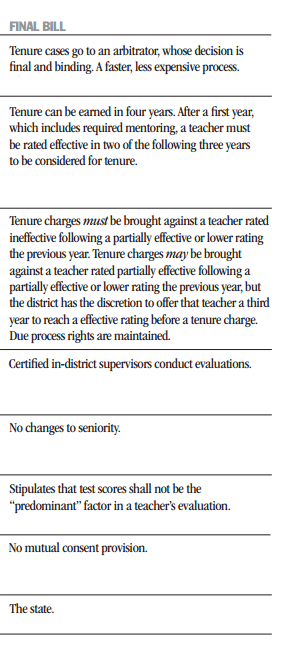
This year I had two student growth objectives (SGOs) that needed to be documented and reviewed as well as a review of my current professional development plan (pdp). My meeting went well. I left feeling valued and with a clear direction for improvement the next year. I have learned how to navigate through a system that cares more about outcomes than process. Others may not be so fortunate.
The one thing that stands out to me is my old friend Maslow’s second level of needs. That level is safety and security. Once we are fed, breathing, slept, went to the bathroom and had sex we look for safety and security. This includes our jobs. Teacher summative evaluations can be an attack on a teacher’s perceived safety and security of their position. Some administrators fail to recognize this. That oversight is a huge reason why there is a disconnect between administration and teachers.
An example of this is that some administrators attempt to coach a teacher during a summative evaluation. This is a huge mistake. Teachers are not open to coaching at this point. You had all year and 2-3 formative evaluations to coach us. Use PLCs, walkthroughs, formative evaluation meetings, or any other litany of contact time to coach your teachers.
I have heard from other teachers that certain things were included in their evaluations that left them feeling unsupported. An unsupported teacher is not meeting Maslow’s second level of needs. When this happens it is very difficult for a teacher to grow. Fear starts to become a motivator. Passion starts to wane and teaching becomes a job instead of a calling.
That being said certain things need to be documented if administration decides they are going down a certain path. Some teachers are not willing to be coached so they need the written documentation in their summative evaluation to either kick start them or allow administration to start the process of putting them on an improvement plan.
Administrators need to be cognizant of why they are giving their staff feedback. What is the purpose of saying or doing something? Do they recognize that one paragraph or even one statement can be perceived as an attack on their safety and security? They need to understand that every piece of feedback or documentation is going to be looked at through the lens of safety and security. Failure to do that is a failure to understand their staff.
My final thoughts on this subject is how and when to give this feedback. Teachers need to be guided and corrected to be made better. This can occur using many different coaching methods as stated above. Teachers need to be open to being coached at the appropriate times. When summative evaluation time rolls around job safety and security comes before self-actualization.
Tomorrow is Field Day. If you went to school in America, have elementary school kids, or work in an elementary school you understand how great this day is. Field Day is a day where students celebrate movement. It may be through games, physical challenges, or competitions. Some teachers set it up as a mini Olympics, others showcase games and events they have done in their class during the year, and others just set up games that will engage the students. It doesn’t matter how it’s set up. All that matters is that for one day students get to enjoy being a kid without the cognitive overload that sometimes is heaped upon them.
My field day is set up so that classes travel to together and engage in games and physical activities. There is a blue team and a gold team but we do not keep score. I am not against keeping score I just don’t see the need for it. I have run my field days previously with a score and found that when I compare the days keeping score added nothing the event. Why bother with keeping points, arguing who finished first, or putting added pressure on students who did not willing sign up for whatever challenge their class arrived at?
Field Day brings me great joy for two reasons. The biggest reason is that my 6th graders run the events. They are the oldest students at my school. They have earned the right and the responsibility to run, what many consider the greatest day of school. (myself being top on the list) I love to see them step up and help their younger peers succeed. They also get a small taste of what it is like to be a teacher. Their judgement calls are questioned, they have to give clear directions, and they have to manage groups of students. Many of them tell me at the end of the day my job is not as easy as I make it seem.
The second reason I love this day is that the entire community is invited. By entire I mean anyone and everyone can show up. People bring chairs and hang out. Grandparents get to see their grandchildren having a blast. Parents see their cherubs dirty and smiling. Board members see what a school looks like where everyone is involved and has a desire to see children succeed. This day is full of fun and minimal if any discipline issues.
Field Day is a day of cooperation, fun, physical activity, learning, teamwork, responsibility, respect, caring, trust, and so much more! How often do we allow our students to get active and focus on the things that kids love while still being able to learn?
Q1: What was your favorite day of school as a kid?
Q2: What did it feel like to wake up on that day?
Q3: What is your favorite day of school now? Why?
Q4: How do you create days that the students will love?
Q5: If you could create a staff day what would it look like?
The end of the year is approaching and people are working hard to make sure we aren’t just mailing it in for the last month of school. Andy Milne (@carmelhealth) discussed this on our Blab two weeks ago. His point was we get paid the same rate for the last two weeks that we do for the first two. According to Andy, our effort should remain the same regardless of what time of year we are teaching.
Jen Hogan, a principal in Alabama, started the hashtag #lastbell for much of the same reason. Here is a large excerpt from her blog:
“Let’s throw that “tradition” on it’s head. Let’s re-evaluate the influence we have on students’ lives. Let’s all join together as an education community to celebrate the time we have left with students. Because, whether it’s August or May, every moment we have with students is valuable.
Starting on May 2, and every weekday during May, the Voxer group for Women in Educational Leadership is leading a movement on social media to celebrate those who teach until the last bell. This movement includes school leaders, classroom teachers, counselors, and support staff, because in a school, we’re all a part of the group that influences children’s lives. We want you to join us for this incredible movement using the hashtag #lastbell!
Let’s celebrate those who bring it in May! It’s easy… just snap a picture, share a quote, and more to let the world know about those people in your school who make a difference for others. You can share this on Twitter, Facebook, Instagram, Vine, Periscope, and/or your blog. Be sure to use the #lastbell hashtag, since the hashtag will be the “hub” for sharing our celebrations!” Resource link
The irony of the situation is that my students are the happiest they have been all year. The teachers are the ones with the burnout. Why are the students so happy? Reason number one is that the weather is changing in New Jersey. The students are playing outside for recess more often now. The movement combined with the sun is making a huge difference. The benefits of recess are so numerous that a school in Texas is giving their students 4 recesses a day!!
Another reason my students are so happy is that there are a ton of field trips planned for the end of the school year. When the students are able to make connections outside of the classroom that is where we succeed as teachers. This begs the question why don’t we do more learning outside of the classroom. I know field trips cost money but that doesn’t mean that is the only way to learn outside the classroom. We can take walking tours, team up with local businesses to see how they operate, or simply learn outside. We can use GAFE outside without a wifi signal and it will automatically synch when we enter back onto the wife.
I have made it a point to take my students outside as much as possible this year. I lose some control when a plane from the local army base flies overhead, a bee buzzes past someone’s ear, or the garbage truck comes making more noise than seems necessary. This doesn’t bother me anymore. Hopefully, the students are associating being outside and moving with enjoyment. This is a huge goal of the physical education community. Create a positive association with movement and the environment. The benefits of achieving this goal are on par with teaching students to read or learn mathematics.
If you are burned out take a look at your class. See if they are burned out as well. If they are, shake things up a little. Get out of your classroom. Go to the gazebo, under the trees, or walk to the park. The time you will lose getting there will be more than made up when the students are happy to be there. This positivity will spread to you and help make you a happier teacher. Take pictures and videos of the people who are making a difference at your school and post them to #lastbell. And remember, you get paid just as much during the last week of school as you do during the first week. Thanks for the reminders Andy and Jenn!!!!
Q1. How do you to get the students out of the classroom when you teach?
Q2. How do you minimize distractions when you leave the room?
Q3. What is your favorite field trip you went on as a child?
Q4. What is your students’ favorite field trip to go on now?
Mother’s Day is quickly fading. The party’s over. Most people are on their way. Their belly’s full of food and drink. Happy memories of children laughing, milestones reached, and the joyous reflection of the journey of life flashes through mother’s heads. For most this is the norm for Mother’s Day. For others, this day is full of sadness. The woman who wants to have children but can’t, the mother whose child died before their expected time, the son or daughter who no longer have a mother to celebrate with or the child who is estranged from their parent.
This makes me reflect on perspective. The same thing has many meanings to many people. Let’s think about this from a classroom perspective. What are we doing that we see as positive yet our students may perceive as something else? This is why it is so important that we understand our students and know exactly how our students perceive what we saying.
Relationships are so important for this very reason. It is the job of the teacher to understand how their message is being received by the student. Does the white teacher understand how their student of color truly understands their message? Does the leader of the school understand truly see how their interactions are looked upon by their staff? How does the parent understand the communications between home and school?
The only way to ensure that what we are doing is truly being received in the matter that we intend it to is to keep constant communication with all stakeholders. This involves asking questions, sending out google forms, emails, conferences, and any other way to ensure that your message is being consumed in the way you intend it to. It is our job to make sure that this occurs.
Q1 How do you send your message to your stakeholders?
Q2 Has any message ever turned out different than you intended? What did you do?
Q3 What do you do to understand your students so that your message comes across as intended?
This week I came across an article entitled “Physically literate and physically educated: A rose by any other name” written by Monica Lounsbery and Thomas McKenzie. The premise of the article is that the term “physically literate” is not a change that SHAPE America needed to switch out “physically educated” for, and could possible damage physical education as a whole.
Before we dissect the differences between “physical literate” and “physically educated” I would like to state with great incredulity how quickly SHAPE America did something!
“Without widespread consultation within the profession (e.g., discussion and debate at national conferences) or extensive committee work or marketing research, the term physically literate replaced the term physically educated in the 2013 release of the U.S. national K-12 PE content standards. The lack of broad engagement in professional discourse and market research prior to this replacement is concerning given the extensive effort the profession previously undertook to define a physically educated person.” link
We hear all the time about how long it takes an organization as big as SHAPE America to make changes; however, it seems that when enough people in power feel a change is needed things can be done swiftly. After reading this article I wonder did they move too quickly? How did they move so quickly from physically educated to physically literate yet completely ignore social media for almost 5 years?
This brings us to the question of why. Why was there a need for SHAPE America to change from the physically educated student to the physically literate student? According to Lounsbery and McKenzie there wasn’t a large clamoring for the change. They couldn’t find any documented criticism of the term “physically educated” or backlash against the 1986 (old) outcomes.
The answer may be in this publication from Dr. Paul Roetert, Chief Executive Officer of SHAPE America, which you can find here.
“Although the case can be made that becoming physically educated in the broad sense is a life-long endeavor, most people identify physical education as a subject area taught within the school curriculum.”
What I surmised from this statement is that the name change was needed because people may have confused the “physically educated” student with the class Physical Education. Is that the only reason why we undertook this massive overhaul?
Another theory some physical educators have is that we are always battling against the “old” reputation of physical education teachers. We have an inferiority complex that has lasted over 50 years. Physical educators are always trying to prove they are “real” teachers. Due to this lack of acceptance we follow general education trends and allow the pendulum to swing wildly from one direction to the other. Lounsbery and McKenzie sum this up purposefully:
“… (in) response to the general education movement to emphasize morals, values, responsibility, respect for self and others (sometimes referred to as the hidden curriculum), PE responded with character education curriculum models. Similarly, when general education emphasized inquiry based learning, team building, and curriculum integration, PE followed with the movement education and sport education models and efforts to increase academic subject matter integration (e.g., math and reading) into PE. Efforts to keep up with educational trends, plus the profession’s own development, resulted in so many changes in emphases over a 50-year period (e.g., play education, developmental education, humanistic education, personal meaning, movement education, kinesiological studies) that PE has been referred to as the “chameleon of all curricula”.
The changes were made before the ESSA act elevated and acknowledged health and physical education as part of a student’s “well-rounded” education. Maybe this will settle our profession down and help them realize we are our own subject that should address the whole child but focus on physical activity and health.
Although the impetus for the change still remains unclear to me let’s analyze what the terms “physically literate” and “physically educated” are defined as. SHAPE America defines physical literacy as, “…the ability, confidence and desire to be physically active for a lifetime.” (link) Physical literacy should focus on the following:
NASPE only defined a “physically educated” individual in the frame of what a “physically educated” student should be able to do:
Now that we understand what the terms are, how are they different? Take a look at Lounsbery and McKenzie analysis of the outcomes (standards) changes that occurred when SHAPE America moved from “physically educated” to the current “physically literate” wording and revamped the standards.
When Lounsbery and McKenzie analyzed the old standards versus the new standards they became worried that physical education had moved away from the psychomotor domain and into the cognitive domain. They stated:
“Table 2 shows that most of the words remain the same, but those that have changed clearly reflect a shift away from doing (2004 standards) to knowing (2013 standards). This is of great concern for us, and it leads us to question whether the difference in being physically literate and physically educated is the difference between knowing and doing?” (link)
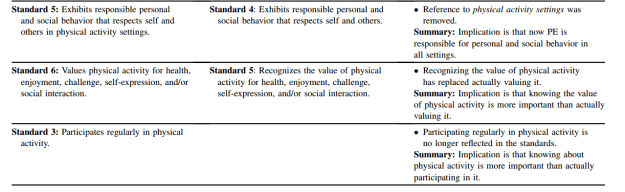
I am not sure I wholeheartedly agree with that statement. Here is my breakdown of their argument. The tables below show their breakdown of the current and previous standards.

Standard 1
Change: “The word variety moved from referring to physical activities generally to referring to motor skills and movement patterns. Competency in movement patterns and motor skills are no longer contextualized as being needed to participate in physical activities.”
Did we really need to have physical activity in that standard? Where else would we be demonstrating competency in motor skills and movement patterns? Aren’t motor skills and movement patterns physical activity? Standard 1 does not support their fear that we are moving from doing to knowing.
Standard 2
Change: “Understanding is changed to applies knowledge. Application to learning and performing physical activities is removed.”
Applying knowledge is a step toward movement not away from it. The subtraction of physical activities and replacement of movement and performance does not mean that physical activities are eliminated. I don’t know any movements or performances applying standard 2 that aren’t physical activities. The change to Standard 2 does not support the argument that movement is being replaced with sedentary learning.
Standard 4 (old) Standard 3 (new)
Change: “Adds demonstrates the knowledge and skills to achieve.”
Lounsbery and McKenzie state, “The standard, once primarily psychomotor, is now firmly placed within the cognitive domain. A PE program now no longer is expected to actually improve fitness or engage students in physical activity.” There are numerous problems with this summary. The first complication of the argument is that if physical education see their students once or twice a week physical fitness is not a realistic goal. Physical education teachers are not fitness instructors. We can not control what happens outside of our class. Fitness is only achieved with regular exercise. Having students for 20-60 min of mvpa per week is not an attainable goal for students to achieve and maintain physical fitness.The change was necessary.
The second problem with this argument is that demonstration does not disallow movement. It is true that the teacher could allow a paper and pencil test to demonstrate but it can also be done by having the students demonstrate through movement activities. I have faith that physical education teachers will assess using movement activities over sedentary assessments.
Standard 5 (old) Standard 4 (new)
Changes: Reference to physical activity settings was removed.
Are we only teaching our students about physical education? I teach students who have lives before and after my class. I would hope what I teach goes way beyond just physical activities. The lessons they learn about teamwork, socialization, work ethic, physical fitness, etc., will be used not only in school but in life. The removal of physical activity settings forces the teachers to understand that we are teaching our students about life not about physical activities.
Standard 6 (old) Standard 5 (new)
Changes: Recognizing the value of physical activity has replaced actually valuing it.
This change makes sense to me. How do we assess if a student values something? Do we send out questionnaires? Have them document them valuing physical activity? Our job is to give the student all the information they need to live a healthy active life. What they do with that information is up to them.
Standard 3 (old)
Changes: Eliminated
I understand that we want students to participate in physical activity but we can’t demand they do it outside of our class. Physical literacy stresses the benefit of lifetime movement which will allow students to be engaged in physical activities before, during, and after our class. When we get students to buy into physical literacy they will naturally be physically active.
In summary, I do not believe that changing the changing the main objective of physical education away from the “physically educated” to the “physically literate” student is a negative. There may be a slight shift to the cognitive over the psychomotor is teachers choose to structure their class in that fashion. I believe that most physical education teachers will incorporate these standards and keep or add mvpa time to their classes.
http://www.physicalactivityplan.org/commentaries/McKenzie.html
http://www.physicalactivityplan.org/commentaries/Roetert.html
http://www.sciencedirect.com/science/article/pii/S2095254615000290
Yesterday I went to to EdCamp Garden State. The first session I went to was facilitated by @mrfieldmanchs. The session was all about social justice. One of the main nuggets I came away with is that in order to have a discussion about social justice we have to start with the definition of privilege. According to the everydayfeminism.com, “We can define privilege as a set of unearned benefits given to people who fit into a specific social group.” Once we understand privilege we can have the hard conversations about our privilege and how that affects our students. I also noticed that I manterrupted @jacq_mccarthy during the session. I apologized to her after the session. At least I am aware of my micro-aggressions these days. The conversations were productive and reinforced that we need to infuse social justice across the year and not just fit them into separate months.
Jacqueline (@jacq_mccarthy) ran a session on Buncee. For those of you like myself who don’t know what Buncee is :
Buncee® is a whole new way of creating and sharing online and mobile greetings, memories, interests, new finds, business stories and more in a unique, fun and social way. By leveraging the capabilities of online tools and iOS devices, buncee makes it easy for even the most ‘non-technical’ individuals to create and share engaging and interactive multi-media creations that can be shared publicly or privately.
Our edu.buncee.com web-based platform provides users with multiple easy-to use tools to add personal photos, text, drawings, and online content such as YouTube videos, Soundcloud audio, flickr, Google, or public Instagram images into a digital canvas called a ‘buncee’ that can be shared among all your social and private networks with just a few clicks.
It was a great session. The part I liked the best was that she gave people the time to play around with the new tool. I think of Buncee as an interactive flyer or slide show. There will be so many ways you can use this product!! I will be using Buncee in the future.
The final session I went to with great trepidation. I thought was going to be a whining session. The session was called teacher burnout. I went on the off chance that it was going to be about how to prevent it instead of just complaining how hard everything is in schools today. There was some complaining but the facilitator was writing down ideas on how what we do in our schools to prevent burnout as well as how to change our school climate. The room was sharing multiple ideas and it stayed positive for most of the session.
One nugget that came out of the session was that one teacher stated he received an email from his supervisor on Friday afternoon that they wanted to meet with them on Monday. The email did not have any details on what the tone or the reason for the meeting was. We discussed how much this bothers teachers. It ruins the nights and weekends of teachers. I understand that appointments need to be made but I am sure that teachers would much rather meet that day then chew on something for an entire night or weekend. Check out this link for the sessions as well as the session notes.
Special shot goes out to reconnecting with my man TJ Mckinney (@tj9er) who was my pseudo roommate in college!! It has been years since we hung out! Kudos to Dan Whalen (@whalen) for organizing and running such a wonderful event!
Q1: What program do you use to make flyers in your classroom? #slowchatpe
Q2: What are your thoughts about Buncee? #slowchatpe
Q3: How do you avoid burnout? #slowchatpe
Q4: What is one tip that helps keep your staff culture warm and friendly? #slowchatpe
Q5: What lessons do you keep for the end of the year to combat student burnout? #slowchatpe
It is late on a Sunday and I am feeling in quite the mood. I am going to use this blog as a #rantchat. I first saw Manan Shah (@shahlock) use this hashtag before on twitter. Here goes my rant:
If you do not participate in a group of Voxer, Twitter, or Facebook do not promote your stuff in that group. It’s super annoying to see people who never do anything in a group drop a link to their blog, their project, or some other work that they want help or input with. STOP! No one wants to live on a one-way street. To be honest I don’t care about your project if you aren’t lifting the profession up as a whole.
The Voxer groups I moderate and participate in are wonderful. People share what they want when they want. People may go weeks or months without participating; however, when they do it’s not to drop a link to some personal project that only lifts them up. They chime in with thoughts, feeling, or sources for information. Then when the time comes they can ask for help from the group.
Dropping your link to a blog or site during a Twitter chat you’re not even participating is the worst!! How selfish can you be? People are actually connecting to get better and all you are doing is wasting their time. STOP!
There is no formal timeline or number of participations that you need to accomplish before you self-promote. Just be an active member of the groups you promote in. We are not your guinea pigs waiting to give more of our time so you can accomplish something.
End #rantchat
Q1: What rant do you have about your social media experience?
Q2: What advice would you give new collaborators about chat etiquette?
Q3: How do you define participation, collaboration, and self-promotion?
Q4: What action would cause you to withdraw from participating in a chat?
Q5: How can you help shift the tone of a collaborative space away from an individual to focus on group growth?
Cleanliness is not next to godliness. Cleanliness is next to healthiness. I spend so many hours a week cleaning something. Vacuuming, mopping, dusting, cleaning bathrooms, washing hands, showering, and brushing my teeth all tasks that seem to never end. I spend so many hours a day cleaning my personal domain but what about my professional domain? Do we expect that same level of cleanliness at work?
A conversation over Voxer brought this to the forefront of my consciousness. A statement was made that their room was really dirty. Much dirtier than their last school. I have to admit that over the years I have heard numerous teachers complain about how dirty their classrooms are. Think about the last conversation you participated or overheard (eavesdropper!) that sounded like this:
Person A: “Wow my custodians are awesome. They cleaned my room so great yesterday.”
Person B: “Yea they keep my room spotless. I couldn’t ask for a better janitor.”
That happens never. I don’t hear these conversations at all. It may just be me. It always seems that janitors/custodial engineers/custodians get a bad rap when it comes to cleaning.
I personally can’t complain. My custodial staff bends over backwards for me. We have a facultative symbiotic relationship. This happened because I put time and effort into our relationships. I help move things, buy them Christmas presents (this goes a loooong way to show my appreciation), and hang out outside of school hours. It also happens that we are 3 of five men that work in my building.
If my gymnasium is dirty I am not scared to pick up a broom to sweep or fill a mop bucket to clean up a spill from the basketball game the night before. This seems like a natural thing to do, yet when I ask teachers why they can’t clean their room they tell me it isn’t their job. I know during germ season lots of teachers will spray the desks and wash all the knobs and handles in the room. Why not help out after germ season?
What are your thoughts on cleanliness in the classroom? #slowchatpe
Q1: How well is your professional area cleaned? #slowchatpe
Q2: Are you willing to clean your area up when it needs to be? #slowchatpe
Q3: How do you create and nurture relationships with custodians? #slowchatpe
Q4: Do your students notice when your area isn’t clean? What do they say? #slowchatpe
Q5: What is a cleaning tip that we should all know? #slowchatpe
 #slowchatPE