
Judgement Part 2 Bias from Mr. Pink

Dear Mr. Pink (@Positivteacha),

First let me commend you on your awesome name. I know it was given to you by birthright but sharing a name with Steve Buscemi in Reservoir Dogs is so cool!!!

Now down to business. I read your blog and felt the gamut of emotions. I have also read your response blog located here. I will have to attempt to dissect your defense of your original blog in a second post.

You started off with a bang!!  We need more crossover dialogue in education. It proceeded to go downhill fast. “When we were growing up, as you were feeling the triumph of scoring the winning penalty for the school team, I was enviously penning poems about what that might feel like.”  You assume that all physical education teachers excelled in sports. Sweeping generalization one. Just talk about how you had a lack of skills in a class that wasn’t set up for you to succeed. The problem is you weren’t set up for success. 

“Today, I want to breach the gap between us and bring us together in the aim of achieving one goal. Today, I am not concerned with our futures, but the futures of the students we teach and I’m concerned with the power and the responsibility that you –PE teachers- have now, to ensure that these students have the physical and intellectual means to access the marvellous futures they deserve.” This would be a grand statement if your entire writing was not designed to enflame physed teachers. Maybe you desired this. It did get the PE community talking about you. Dialogue has ensued as a result. Maybe you are taking cues from Donald Trump. (American political reference if unaware)

“Who has the most power to influence this change: Mrs Smith from Geography who ‘only buys Waitrose’? Mr Jones from History who road bikes around France in half term? Mr Pink from English who eats pastrami and rocket sandwiches? The answer, of course, is none of these. The answer is you.” You renounced all power and authority to physical education teachers while simultaneously disregarding every relationship that non-PE teachers have with their students. I am happy we are getting credit but you may be doing a disservice to every other teacher in the school.

“As a casual, and slightly envious, observer of the influence you possess, I want you to know I’m fed up. I’m fed up of fifteen year old captains of sports teams proudly telling me, someone they should want to impress, that they’ve, ‘never finished a book’.” Another sweeping generalization here. How does playing a sport or being a captain have anything to do with reading? It seems to me that they don’t value reading. That is the problem here. I would worry about that more than what they do value. It’s not an either-or proposition. The bigger problem here is that you combine sport and physical education together. In the United States, physical education is much more than sports. I have many physical education connections in England and they teach much more than sport. Your blog should have been targeted to coaches not physical education teachers if your problem is with captains and sports teams.

“I’m fed up of hearing students – and teachers-, perpetuating the false dichotomy that people are either ‘clever’ or ‘sporty.’ If smart people can become more active, active people can become smart.” Agreed. Smart people can be sporty and vice versa. Again not an either or proposition.  

Here is where it gets real repugnant. “Please, stop picking naughty boys for your school teams.” This may be a cultural misunderstanding by my, but I fail to see how not reading makes a boy naughty. Boys who are bullies, kick puppies, or don’t follow their parent’s instructions would fall into this category. If your students are not reading it is more an indicator that they don’t value it than labeling them as naughty.

Here is an epic fail of mammoth proportions. “If they refuse to exercise their brains, then they shouldn’t be exercising their legs.” Under this logic, students aren’t learning anything when they exercise or play sports. This is an asinine statement. Here is the first article of 160 MILLION hits that came up when I googled learning by playing sports. They may not be learning what you deem as acceptable but then again your entire blog was written with bias and contempt.

Our job as physical education teachers is not to provide discipline and classroom management for your class. You state, “If they’re proving themselves in Science or History or ICT, give them the opportunity to prove themselves on the field.” How about we switch that and say if they are not proving themselves in physical education don’t give them the opportunity to participate in English? It doesn’t work that way sir.

This paragraph is filled with innuendo and reeks of disdain. “Get your tracksuited torsos into assemblies and tell students what you’re reading. Tell them about your favourite books and how reading has benefitted you personally. If you don’t read yourself, start and start now. It’s never too late. There’s lots of books out there, and they’re not all sports biographies. Try genres you’ve never tried before and get students to do the same.” My offense at this nonsense is that you are telling me what to do and “enlightening” people that there are numerous books in the world. Did you really think that we didn’t know how many books exist in the world? I offer you this. You support my class and I will support yours. I read constantly as well as exercise. I would love to talk about what I am reading. Do you exercise? What are you doing to show students how important physical activity and physical education is? I hope you will respond that you do this in numerous ways.

I don’t know what your definition of an athlete is. If it is making students physically literate than you are wrong when you declared this, “The students who love your subject won’t all become athletes.” If you believe that our goal is to create and train athletes you are incorrect. Our goal is to instill in our students that a lifetime of movement and physical activity is the only way to remain healthy.

If I had to pinpoint one problem with your post it’s that the tone of the post is in direct opposition to the goal of uniting teachers in the best interest of students. I left wondering why students don’t want to read after attending your class. That is not an attack on you but a simple musing of why they don’t see the value in something as important as reading. In your defense, I reflect on why some of my students don’t leave my class with the admiration of lifetime movement and activity that I would like to see in them. Maybe reflecting more on your practices may help instead of imploring physical education teachers to inspire your students for you. 

I conclude with this thought. Work with us and let’s build our students up together. Take an honest look at your blog and see where your bias lays and how it affects your writing and outlook. Let’s turn that frown upside down and join forces instead of writing divisive and inflammatory blogs.
Sensible Conclusions


Judgement is the ability to make considered decisions or come to sensible conclusions. (google it). I would like to concentrate on the making sensible conclusions part of judgement. As Hoobastank sang; I am not a perfect person. I have noticed that I making conclusions. A lot. As soon as I noticed it bothered me. Haven’t we been told “Judge not, that ye be not judged”? The first instance came when I was on Facebook and visiting the PE Central thread. One woman stated that she gives the fitness test to her students every month. Instead of trying to understand her position I automatically made a sensible conclusion and told her what she was doing was wrong. Was I telling her this because fitness testing students every month was wrong or did I make the sensible conclusion that fitness testing is not the best use of classroom time?


My thoughts then turned to my teaching. I make snap sensible conclusions 1,000 times a day. When two students are arguing I usually know who is wrong before I even get involved. When a ball goes flying across the gym and I see two students standing near where it was I can tell you who was the one who kicked it without even seeing who did it. I make judgements about my students all the time.


So what is the problem with judging? We all do it. We are biologically programmed to judge things. John Medina writes about attention and judgement in his book Brain Rules. He states, “Can I eat it? Will it eat me? Can I mate with it? Will it mate with me?” Those all seem like good reasons to come to a sensible conclusion. Where does the problem with judgment come in?


The problem with judgement is that people can only judge by using their own biases and experiences. When I judge people on social media am I fairly judging them? When I judge my students’ decisions and efforts in class I am using my own lens and perspective. Therein lies the worry. I am judging based on my views and experiences in life. This is where my race, socioeconomic status, religion, sexuality, and culture all play a huge role in the judgements I make. It is impossible to separate my judgments from my biases without metacognition.


One example of bias I came across is an article published by Psychological Science.

“Across both studies, the researchers found that racial stereotypes shaped teachers’ responses not after the first infraction but rather after the second. Teachers felt more troubled by a second infraction they believed was committed by a black student rather than by a white student. In fact, the stereotype of black students as “troublemakers” led teachers to want to discipline black students more harshly than white students after two infractions, Eberhardt and Okonofua said. They were more likely to see the misbehavior as part of a pattern, and to imagine themselves suspending that student in the future.”

That study should worry you. It should make you think long and hard about what your biases are and how they impact your students.  


Q1. How do you avoid judging coworkers? #slowchatpe

Q2. How do you reflect on your biases? #slowchatpe

Q3. What makes you think a student is not a nice child? #slowchatpe

Q4. How do you ensure your classroom management is fair? (appropriate not equal) #slowchatpe

Q5. Who is the most nonjudgmental person in your life? How do you know? #slowchatpe


The Evolution of Voxer Use

This is a joint blog with Dr. Dorian Roberts and Justin Schleider

Introduction by Dr. Dorian Roberts.

Remember when you were a toddler and after you took a bath you would run around the house naked until your parents stopped you? You ran laughing, somewhat knowing that you could do something that no one could do except for you.  You took some type of pleasure in it… some type of joy… remember how you would giggle and laugh really hard.  HeeHeeHee… good times, fun times, lost times, and I never thought I would get those chuckles again until July 2015 when I was introduced to Voxer and then a group called #Edumatch.  

So, recently reflecting on Edumatch, Justin and I noticed something with the new “youngins” that have joined the group.  These latest members seem to be following in our footsteps through some rather organic stages of Voxer/#Edumatch.  In this collaborative blog, we are going to discuss what we ourselves have experienced and now dubbed as the “Stages of #Edumatch”.

Dr. Dorian: Stage #1 The BIG OLE SHINY BALL COMPLEX

In #Edumatch, there are all kinds of balls—big balls, small balls, tiny balls, blue balls, red balls, every kinda of ball you can think of… balls—meaning DIVERSITY! (So get your minds out of the gutter.) LOL!  Look back at Stage 1… Did it catch your eye and cause you to scroll down to get to the good stuff?  If it did, don’t feel bad because it happens in #Edumatch all the time.  People are listening to the “hot new topic” being discussed among educators.  You hit this green button and BAM! You are instantly heard. The POWER, the CONTROL—you have it all with that green button.  You have a captive audience.  And then… wait for it… wait for it… chirp, chirp… you have a notification.  Someone else has heard what you said and agrees with you.  Someone hears your cause, your joke, your story, your journey and all of a sudden, you feel validated.  You feel at home.  You have, at last, found your people.  

Justin: Stage 1: Existence; This is so exciting!
This stage is where you keep voxer alerts on. You are waiting for someone to say something so you can jump in. You are so excited to be a part of a group with so many teachers from all over the world. You are making comments and super excited about every conversation. You go to other rooms to listen to the conversation. Housework is only done with Voxer. You stop listening to music or podcasts. Voxer has overtaken your life. You are hooked.

Dr. Dorian: Stage #2 I’m too SEXY FOR MY VOX!!!! or “I’ve Said what I’ve said,” by NeNe Leakes of The Real Housewives of Atlanta

This stage is the confidence stage.  This stage is hilarious.  Why? Because we have all done it with maybe one exception, the founder and creator @Sarahdatteecher. In this stage, you let your “expertise” show.  You make your stance known to others in the group. Your opinions become statements.  Here’s where it gets fun… disagreements are made, Voxer battles are created, sides are taken and voxes increase.  That’s right, you named it… “The Debate”. Now, what is funny to me is that people actually leave chats and Voxer groups over differences of opinions or sore feelings.  Really! I’ve seen it happen.  You may ask me how I handle disagreements? “I’ve said what I’ve said!”  I fight daily, but I never turn my back on family.

Justin: Stage 2; Fight or Flight

This is the stage where you stand up for yourself or you tuck your tail between your legs and run away. People start to really let their opinions and feelings be known. They are willing to step up and debate their point. This is where Voxer can be at its best. Debates can get heated but most understand it is all about the subject and not the person. The most the debates last is two days before the next subject is tackled. You can really grow from these interactions and be challenged by some of the best and brightest educators in the game.

The flip of the coin is those who run away. They don’t like the pushback. They feel personally attacked. They leave the group. This is fine as well. The best part of social media is if it’s not working for you, bounce! Leave. Why stay in a place of your own choosing that makes you upset or uncomfortable? The only problem with leaving is that you may be leaving the only place you will get honest feedback. We all know that group think runs abound. The longer you use social media the more this is apparent. Remember pushback allows you to grow!

Dr. Dorian: Stage #3 The CLASSICS

When you put on your grown man or woman pants, this is the best stage.  This is when you create a Voxer group of your own that has nothing to do with education.  It is where you go to let your hair down, smoke a cigar, drink you favorite wine and watch a movie together with your crew… yes, I mean literally watch a movie together.  In this group you do things like have Reader’s Theatre, Mock Trials, play Voxer tag, sing karaoke, and I could go on and on. This is a place where the “seasoned” #Edumatcher goes for a good old-fashioned resort vacation.  I love it there!

Justin: Stage 3; Make Voxer Your Own

This is the stage where you find your tribe. It is almost like the direct message groups I wrote in an earlier blog about Twitter. This is the stage you start a spinoff of the group. This group is a couple of other people who share your views.  You start to talk about people or subjects that you don’t want public. You code switch to a much more informal tone. The subjects you discuss are not just education related. Personal relationships are cultivated. You learn much more about the individuals in these small groups. The conversations flow much more freely. You sing on your way home and let them know when something in school really ground your gears. This is the sweet spot of Voxer. Finding likeminded people who you can be your authentic self around without the censorship and decorum that large chats with people you don’t know demand.

These stages aren’t written in stone. They are what Dr. Dorian and I have noticed over the months and years on Voxer. We both believe it is a game changing application that will elevate your professional and possibly personal life in ways that were inconceivable before. If you haven’t tried it we would both highly recommend it to you. Two great groups to check out is Edumatch for general teachers and the General Physical Education chat for physed and health teachers. My voxer name is SchleiderJustin. Dr. Dorian Roberts voxer name is Dr. Dorian Roberts. Hit us up if you need any help with Voxer.

Q1. What is the first thing you do when you join a new group on social media? #slowchatpe

Q2. What made you confident enough to chime in during group discussions? #slowchatpe

Q3. Have you ever left a group on social media because you felt attacked? How did it make you feel? #slowchatpe

Q4 What made you start a direct message group on twitter or side vox group? #slowchatpe

Q5. What is a voxer group that people would find enjoyable? #slowchatpe


Hip Hop Chess

As much as I love being the non-conformist I would be remiss in writing a blog on the week celebrating Martin Luther King Jr. and not draw attention to it. To me Dr. King’s birthday is the unofficial jump off of black history month. It opens up the conversation in our schools about the history of black people in America. This normally would have been the classic slavery and inequality for people of color is a black eye on American history and is still continuing to this day blog. That was until @sisyphus reposted this blog by Adisa Banjoko and Arash Daneshzade. I did not have any prior knowledge of who Adisa was but I was very familiar with Arash. His posts on twitter frustrated me on many levels (@A_Daneshzadeh). The first problem for me is that his use of vocabulary is so extensive I had to look up every other word. The second problem was that I wasn’t seeing many answers about how we can fix things. It looked like a lot of complaining about the problems in education without giving any answers. I was completely WRONG!

Here is an excerpt from the blog cited above:

Teaching students, “The World Is Yours”

A few years ago, I was asked to speak at a high school for Black History Month in San Francisco, CA. Their original speaker had bailed on them, at the last minute. Rather than open my talk with a lamentation of US slavery, I focused on Dogon discoveries in Astronomy, and Moorish science contributions that served as the foundation of the European Renaissance. After citing the role of the African Islamic influence of Europe’s’ rise out of the Dark Ages, I asked the students how many enjoyed what they heard.  Almost all the hands went up. I said, now ask yourselves this question: How is that you have been in school for at least 9 years and this is the first time you are hearing it? It is against all political, social, and economic odds that Black children are expected to excel.

As we approach Black History Month in 2016, I’m already torn between my genuine love in celebrating Black achievement, and the sad circus many schools turn the opportunity into. American schools have a long way to go in sharing the more dynamic aspects of African contributions to global civilization.

That is just one small insert from an article that is amazing. I did some digging.  It turns out that Adisa Banjoko is the Founder of the Hip-Hop Chess Federation (HHCF) and author of Bobby, Bruce & Bam: The Secrets of Hip-Hop Chess. Arash is a Hip-Hop chess instructor as well as an educator. After doing a quick google search I found this on the Hip Hop Chess Federation website:

Since 2006, HHCF has introduced and taught thousands of youth the game of chess not only as a game of wit  but also as a metaphor for the importance of incorporating strategic thinking as a necessary process for making the right moves in life.  Coupled with the practical philosophies and disciplined teaching of martial arts and framed in the many positive, but often underappreciated aspects of HIP-HOP Culture, HHCF continues to expand its educational outreach efforts throughout the United States. HHCF has spent many years deepening the valuable relationship it has forged with local schools and various community based organizations by being able to provide life enriching programming in a safe setting to youth who otherwise have limited access to high quality alternative learning, culture and arts experiences. The HHCF uses its unique program as a platform to promote the idea that every young person is High In Potential and has the capacity to Help Other People (HIP-HOP framed differently).

Playing chess is fine and dandy but what does that have to do with education you may be asking yourself? I was asking myself the same thing when I read this a little further down on their site :

Research shows that student test scores improved by 17.3% when regularly engaged in chess classes, compared with only 4.6% for children participating in other forms of enriched activities.  In approximately 30 nations across the globe, including Brazil, China, Venezuela, Italy, Israel, Russia and Greece, etc., chess is incorporated into the country’s scholastic curriculum. Just as athletics are a part of the required agenda at schools in the United States, chess has been that way in the European, Asian and African Nations abroad. Chess is a universal language for young people across the globe.

I don’t care much about test scores but I know my administration does!! The wheels started turning. What can I do as a physical education teacher? Then it hit me! To celebrate Black History month, I can teach chess in my class. If you are asking what does chess have to do with black history here is the answer from the article that Arash and Adisa wrote:

Today, most Americans think of chess as an upper echelon “White” game. In fact, the game only made it to America after the Moors (African Muslim scholars) conquered Spain from 700 AD until 1400 AD and brought their books and chessboards with them. After teaching the game of chess to the Christians and Jews, it spread across Europe. The English loved chess and when some rebelled and settled in America, so too did the game. Colonial Americans such as George Washington, Ben Franklin, and Thomas Jefferson became obsessed with the game.

My teaching of chess will be much different. My students need to be active. Most do not know the first thing about chess. I will introduce the history of chess to my students. The next step will be to set my gym up as a giant chess board. I will use poly-spots to mark off the dark squares. We will use the warm-up to go over each chess piece and the movements it can make. I will accomplish this by using the Gifs I created here in the shared Physed Google Drive. An example of this would be all the students would be pawns. They would be asked to jump the appropriate amount of spaces forward a pawn could move on either its’ first move. We would then move on to all the other pieces using various locomotor movements for each piece. This would teach them how each piece moved.

Once the students understand the pieces they can play online for free using their Chromebooks or iPads.  One site they can use for individual play is http://www.sparkchess.com/. Another site they can play versus each other is http://en.lichess.org/. I will have a timer set for 45 seconds. When the timer goes off the students will have a choice of two physical activities to pick from. As soon as they complete the activities they will go back to their game. I may tinker with the time or have the student choose a movement to do after their chess move is complete. The lesson, in theory, is always different than the execution in real life!

Q1. What does Dr. King’s birthday mean to your class? #slowchatpe

Q2: What role models do your ss have that are PoC? #slowchatpe

Q3: Have you gone to martinlutherking.org? How is this a lesson we can pass on to our ss? #slowchatpe

Q4: How do you identify your racial bias? #slowchatpe

Q5: Who is a resource that you rely on to help you with sensitive issues? #slowchatpe


Differentiation

One of the hardest things to do is differentiate. We hear the word all the time. What does it actually mean?

Differentiation refers to a wide variety of teaching techniques and lesson adaptations that educators use to instruct a diverse group of students, with diverse learning needs, in the same course, classroom, or learning environment. Differentiation is commonly used in “heterogeneous grouping”—an educational strategy in which students of different abilities, learning needs, and levels of academic achievement are grouped together. In heterogeneously grouped classrooms, for example, teachers vary instructional strategies and use more flexibly designed lessons to engage student interests and address distinct learning needs—all of which may vary from student to student. The basic idea is that the primary educational objectives—making sure all students master essential knowledge, concepts, and skills—remain the same for every student, but teachers may use different instructional methods to help students meet those expectations. source

Physical education is made for differentiation. We can set up different skills challenges for different levels. (which I allow them to choose) We can also set up different games for those who want are self-proclaimed experts, intermediate players, or beginners. We can mix students up and give the experts a low reward for completing the task and the beginners a high reward for completing the tasks.

Another way we can differentiate is to have various QR codes linked to videos demonstrating various levels of skills. They can choose to scan the beginner, intermediate or expert levels. I am sure I am leaving a ton more ways to differentiate instruction in the physical education environment.

@joeyfeith uses the experts as coaches to help the others. This is an effective way of engaging the students who are our “high flyers”. I believe this is also a higher level of DOK, Blooms, and Solo taxonomy.

We can also use different ways to assess our ss on the mastery of the skill. Some students can create videos, others demonstrate in a game while others teach their classmates. A lot of leeway hinges on the verb in the standard.

This week I had two high-level students that were completely disengaged in the foot dribbling skill and activity. They upset me because they were continuously off task during the entire class. Whenever I get upset I have to remind myself that these are students and that they aren’t off task to personally make me mad. If that sounds stupid you probably haven’t been a teacher before. Students do things against the “rules” or accepted norms all the time. The first reaction of some teachers (myself included) is to feel like they are being disrespected.

I kept the students after class and had a discussion with them. I asked if I had ever treated them disrespectfully, talked down to them, or did anything they found to be rude. They responded no. This validated to me that my personality or teaching style was the problem in this instance. I asked them what they problem was. They stated they didn’t enjoy the skill practice or the drill activity we had done in class. This is usually where I give my, “If you don’t like math or Spanish activity are you expected to participate” spiel but I tried a different tact. I asked them both to create a game or activity they would enjoy playing. They were to create a google doc and share it with me before next class.

I was somewhat pleased with this scenario until I read @sporticus blog today. It made me think. What if I introduced the skill and went right into more small sided games? Do I need the longer skill practice? I usually tell the class they can’t play the game until they master the skill but is that the right order? Can we master the skill while playing the game? At the very least if everything else is a wash is playing the game more enjoyable than just the skill practice?

My idea is not to swing the pendulum all the way to the right and say here is the skill let’s play the game. @btcostello has warned me about changing too hard in the other direction. What if I introduced the skill, did a super quick skill practice, then went right into the game? The rules to the game are always changed to emphasize the skill anyway. The games are small sided and everyone is active.

What are your thoughts? Do students need to master the skills before you play the games?

q1. How do you differentiate in your class? #slowchatpe

q2. What is your response when ss are off task in class? #slowchatpe

q3. Do you ever use student coaches in your class? #slowchatpe

q4. Do ss need to master skills before we play games? #slowchatpe

q5. Who is a differentiation expert we should know about in ur #pln?

Technology Take Back

Technology is a mainstay in my class.

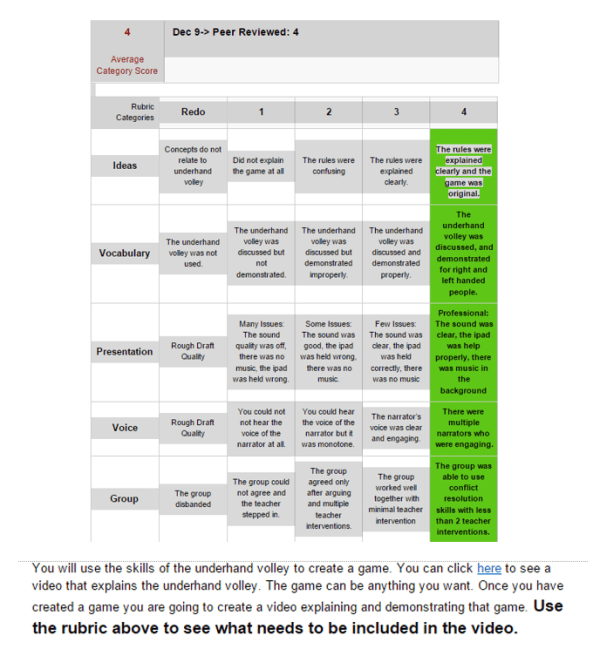
This unit I had my students create a game using the underhand volley. The directions were written beneath the assignment and a video was attached to the assignment so the students the lesson was “flipped”. Groups were posted in Google Classroom. I created a rubric using the google add-on Orange Slice. The students downloaded the orange slice student add-on so they could self-assess before handing in the project. I downloaded the teacher Orange Slice add-on so I could assess the project after it was turned in.

The students were to demonstrate the underhand volley and the game on video. They were then asked to pull the video into iMovie, delete the background noise, annotate over the videos explaining the game and the skills, and insert background music. They were then asked to submit the videos.

blog_pic_

The students did a great job on the assignment. There was a problem, though. It took an extra class period than I had expected. I had crossed over into technology overload. One class, I completely canned the project and changed the lesson on the spot. This blog is not about how great technology is. It is about recognizing when I have gone too far. When the idea of technology juxtaposes with the reality of utilizing the technology.

My goal was for students to create a game using the underhand volley as well as understand and demonstrate the underhand volley. I took it too far. I fell in love with a finished product that I could show off to my PLN and say look at how great I am at having my students use technology. My students did not get the activity time they need and deserve. Technology did not enhance their learning enough to justify using it in this manner.

I could have had the students demonstrate the underhand volley using nondominant and dominant hand videotaping right into the google drive. They could have shared those videos with me. They would then go right into the game they created. This would maximize moderate to vigorous activity time and minimize time spent on technology.

My next two weeks technology will be on hiatus. I will get back to having my students move more and stand less. Our formative assessments will be done by me. We will get back to basics for a bit while I analyze and reflect how to balance the need to use technology with the need for students to move and practice skills.

Q1. Have you ever gone too far using tech? What did you do? #slowchatpe

Q2. How do you make sure you balance tech & activity time? #slowchatpe

Q3. How much teaching of technology do you do? #slowchatpe

Q4. Merry Christmas!! #slowchatpe

Q5. Merry Christmas!! #slowchatpe


3 Changes to the Education System

My mind is on overload. Eric Sheniger is participating in a book study on Voxer with us. The book we are discussing is Uncommon Learning. (written by Eric) The chat has me reflecting on the education system.

The federal government just gave the state the rights back to education. (read here) This is encouraging news for education. What is not encouraging is that as an education system we still rely heavily on testing and sorting our students by age. I would like this blog to be the start of a conversation. The conversation should center on three statements that I believe to be true.

Statement 1: Grouping students by age is not the best way.

Some of the resistance I heard was about students having a lower self-esteem being in a class with younger school mates. My first thought is that students wouldn’t feel poor about themselves if multiple classes did this. It would be the norm. Students play with each other naturally.

                The picture of a group of children all nearly the same age playing in a school yard may seem familiar to modern eyes, but it is an odd image from the long perspective of human cultural and evolutionary history. As anthropologist Melvin Konner pointed out more than thirty-five years ago, play among children close in age (same-age play) is largely an artifact of modern times.1 Same-age play became common only with the rise of age-graded schooling and, still more recently, with the proliferation of age-graded, adult-organized activities for children outside schools. Over the history of our species, as natural selection shaped the brain mechanisms of play, children’s social play usually occurred among individuals of different ages, often widely different ages. I would highly recommend reading this article that highlights the Sudbury Valley School.

Another statement I heard was that teachers are differentiating in their classes. Here is the problem with that. A 4th-grade teacher may have students ranging from 2nd-6th-grade math levels. Are teachers really differentiating five grade levels? Do they know the standards of 2nd-6th-grade math? Here is an interesting article to read about this.

I am not blaming teachers at all. It is hard enough to teach one grade level worth of content. What could be done is we can have teachers teaching 2-3 grade levels worth of content set up at a student’s pace. When the student is ready they could move to the next level. Data could be tracked to make sure this was happening. Students could progress at their pace. If they paced themselves out of the class they would join the higher class. It wouldn’t matter that they were joining a new class and would have to start at the beginning because the class was self-paced! The student would just start from the beginning. The next year they would continue wherever they left off.

Statement 2: Classes should not be broken down into individual subjects. English Language Arts and Social Studies should be one subject. Math and Science should be one subject.

Mike Ritzius (@mritzius) was the first person to put the idea into my head about combining classes. He actually did it with astounding success at his school. Unfortunately, the idea was not supported even though the data showed how successful of a program it was.

Math and Science walk hand in hand. I may even go as far as to say that Science is Math. Why do we separate these subjects?

Mathematics is used in Physical Science to calculate the measurements of objects and their characteristics, as well as to show the relationship between different functions and properties. Arithmetic, algebra and advanced mathematics may be used.

Arithmetic and algebra is used to establish values and solve simple equations or formulae.

In classical or everyday Physics and Chemistry, normal values are used to solve equations. In Astronomy, distances, sizes, and masses are very large. Special nomenclature is required to represent these values. In Atomic Physics and some areas of Chemistry, sizes and masses are small, although quantities may be large.

Arithmetic consists of simple operations with numbers and values. Algebra is used to show relationships before the measured numbers are used for calculations. Higher math is used for complex relationships between properties. (http://www.school-for-champions.com/science/math.htm#.Vmx1kkqDFBc)

Social Studies is reading and dissecting history. Isn’t that a part of English Language Arts? We have to read non-fiction in school. History is non-fiction. (I know a lot of history is from the point of view of the winners and skewed) Couldn’t we combine them? I ran across a curriculum with a scope and sequence that used UBD and is based on New York State standards. Click here

Statement 3: Movement and technology should be incorporated into every class.

I try not to make blanket statements. This one is a no-brainer. Students should be moving every 15 minutes. You should be moving every 15 minutes. There is a ton of research to support this. It can be as easy as doing a walk and talk or you can use one of a million brain boosters. Read this  to get a better idea of why students should be moving in school.

Technology should be used by you or the students every class. I understand some lessons do not need technology for the actual information to be learned. Examples of this could be scientific experiments, playing an instrument, or reading a book. We can use technology for reflection, keeping track of progress, documenting the lesson with video or pictures. There are very few if any lessons that I have come across that could not be enhanced with technology in some shape or form.

The biggest obstacle to my idea is scheduling and flexibility. Class size would be fluid. How would specials be able to cope? Would parents be on board with this change? All I know is that things need to change if we truly want to say, “We do what is best for our students.”

My mind is still wrapping around how the educational system can be transformed using these three statements. I would appreciate any pushback or feedback about my assertions. They are in no way shape or form set in stone. I come from the vantage point of a teacher and former student. I would love to hear how administrators, parents, board members or any other stakeholders feel about my statements.

Q1: Do you believe that grouping students by age is the best way? #slowchatpe 

Q2: Should classes be broken down into individual subjects? Y?#slowchatpe 

Q3: Should movement be incorporated into every class? y? #slowchatpe 

Q4: Should technology be used in every lesson? #slowchatpe

Q5: Who pushes your thinking the most about changing the educational system? #slowchatpe 


To Blog or Not To Blog

This blog was a joint effort between Doug Timm and Justin Schleider. We came up with the ideas after #satchat on Saturday on the topic blogging.  As you read below, keep in mind these are thoughts written to promote thinking and not necessarily how either of us feel about blogging in general.  We think you can relate, connect, and see yourself in many of our questions and arguments back and forth.  The whole conversation is an internal dialogue where Doug took one side and Justin took the other.  We tried to separate these by using different colors.  

I am ready to start writing.  Why am I blogging? Is it because I have a great thoughts that need to be hashed out in more than 140 characters?  Do I want everyone to see me? Read me? ReTweet me? Tell me how great my writing is?  Maybe I am needing to blog to push other people’s thinking. There are a ton of people that could benefit from me pushing their thoughts. Or is it metacognition? Metacognition is defined as the, “Awareness or analysis of one’s own learning or thinking processes”. http://www.merriam-webster.com/dictionary/metacognition Am I writing so that I can shape my thoughts about something? Maybe it is a combination of all the above. All I know is that I need to write. The keys on my keyboard have been silent for so long here goes nothing.  

Ok just finished. Wow that was quicker than expected. Time to send.  Here I am, ready to send my words out to the world, I do this all the time, but for some reason this time is different, I have voices in my head!  I pause before I hit PUBLISH and then it happens, thoughts and voices overwhelm me from 2 very different perspectives.  Here is my internal conversation.

I am scared, what if my message is not what I am really trying to say?  I have read it 5 times and still am unsure if what I wrote is worth blogging about.  Just because I have thoughts, does not necessarily mean that someone else wants to read them.  I flash back to a childhood story when my grandmother yelled at me for barely being able to read, and she said that I would never be able to write. She was a honors high school English teacher, she should know these things.  

Forget the haters. I have a voice that needs to be heard. Have you read some of the stuff that is out there? I have a real voice that needs to be heard. People need to hear me. Maybe someone else is going through the same things I am! If I can reach one person and help them through their journey it is worth it. I want to be heard! Isn’t that what blogging is all about, being heard?

It is about being heard, but I am unsure of my message constantly.  What if  people perceive me in a way that is negative?  My biggest fear is feedback and the thought that someone is at home on their couch laughing at me or thinking I am stupid.  I never liked school growing up and hated writing.  My handwriting is still barely legible and when I write I am constantly erasing and writing over again.  My ideas seem boring or retreads of things I already have read.  Why do I not feel original.  Why do I feel like another grain of sand in an ever increasing beach of mediocrity?  Why do I question myself so much?

Some may think I am stupid. Maybe I am. I was stupid enough to get my bachelor’s degree. I am stupid enough to be a leader in my school. Maybe I am stupid enough to break through the flow of noise and bring a new perspective with this blog.  So why I am not a “writer”. I mean after all what is a writer? Someone who writes. Didn’t I just write a blog? That makes me a writer.

I am not a writer, I don’t use fancy words or imagery, I don’t push anyone, I see what I write and I think “not that interesting.”  I have these thoughts all the time.  Why would someone else want to read my verbal diarrhea.

I don’t use fancy words because the message is what resonates with people. My vocabulary isn’t extensive.  If this wasn’t published for the world it would have much shorter (4 letter) words in it!! People want to hear my message, not use a dictionary to figure out what I am saying.  Why use big words when everyday words do the job just fine?

I really want to push people’s thinking. Let’s be real, no one really likes to be told their views are wrong. I talk about growth mindset and think I am living it.  People ask to have their thinking pushed, but do they really want that?  Every other answer in every Twitter chat from now until the end of time is growth mindset. I have the ability to push their thinking. This blog will push people in a way they have never been pushed. It is real. Authentic. Different. It is me. No one else has my perspective. People want that. People Need That.

Because I want to inspire, not just push a message.  Is that so hard to understand?  I want my other voice to stop fighting with me, I want to be the best I can be, and my writing should be proof of that.  I just don’t feel worthy…   

I am not better than anyone else, but I am something special. My ego understands this. My ideas may not be new or revolutionary, but they belong to me. They are my ideas that I need to put on a page. That is all I can ever ask of myself.

I have done this before… I have tagged a lot of people and threw this up on multiple hashtags as well as Facebook, Google+ and other social media outlets.  I felt shame each time as I know I am not worthy.  Each of those previous times I kept my mouth shut to my other voice!  I did not speak up! I allowed my other side to overwhelm me!  I don’t know that I want what my other side wants.  Do I need the pats on the back through favorites, comments, retweets, +1, you get the idea.  Do I need those as motivation, because without them, what am I?  It wasn’t always that way…   It used to be about a “thought” and trying to put “thoughts” to paper to work out the kinks.  Is my reason for blogging now becoming diluted and shallow.  It is not about me, or I should say, it is about me, but not my thoughts, but my name.  It is about my name and I need that high?  This is why I am speaking up to my other voice.  Am I starting to feel shameful?

Stop. For real! You are way overthinking this!  Who are these “edu rockstars” that people swoon over. Why are they so popular? They are people. People who have a message. People who put their pants on one leg at a time.  My message is just as important as theirs. People need to hear my message. The more people that hear my message and read this the better. The more retweets and conversations that this can start the better. It doesn’t matter that I don’t participate in the Twitter or Voxer chats that I drop the link to my blogs in.  Those people get me and they want my words!  All that matters is that people will read it. I can start conversations they never would have had before.  My message is important because it is me!  I am going to tag everyone and any hashtag that is out there.  I am not going to feel guilty about it. My message needs to get out.  

Do I want people to know who I am? Yes. Yes I do. I want people to know who I am and what I do. Does that make my blog any less worthy? No. The bottom line is that my blog is me. If people don’t like it that’s ok. I still need to get my voice out there. It will help more people than it will hurt.  That was my original question at the beginning.  Why am I doing this?

I know I like to write, but who is it for? I still have not totally answered that question.  What do I want?  Who do I want to read this?  Here I go again with endless questions!  I can’t stop thinking that my other side has a really good point.  Does sharing to a larger audience dilute my message?  Especially if I send out “words” all the time.  Does this just become noise like a car with a really loud sound system that drives by?  You look, maybe just for a second, but once the noise is gone, so are any thoughts.  If I could just figure out my motivation in blogging and is it covering something up?  How has my evolution led me to this moment?  If I knew that I probably would not have spoken up.   

I want people to read this. As many as possible. This may help them or it may help me. Either way it will help someone. Maybe it will cement someone’s position. Maybe someone will realize they disagree with me. Doesn’t matter. We are thinking, reflecting, metacognating (made that up). The number doesn’t matter it could be one person or thousands. The important part is that this blog will push me and possibly others. Isn’t that what we want?

I make sense, I really do, but why did I speak up?  Why am I here?  What is my purpose?  I am important too and I will not stay silent any longer.  My back and forth with myself is not a competition although at times it feels that way.  It is a struggle, a battle, with no winner or right or wrong.  Those situations are the most difficult, but I guess that is life in general, why can’t I accept that?

My finger slowly goes to the touch pad to PUBLISH… Should I?  Why all of a sudden did I question my motives? who is my audience? why do I write?  Now I question myself, is that a sign?  The tension in my head is overwhelming me to the point of sweating.  Who am I? The confident blogger that self-promotes with really no discourse, or the one that is thoughtful about topic, audience, form, and ideas?  Or am I both? Maybe I fall somewhere in the middle. Should I PUBLISH this one? The top is spinning…...Click to see if I posted
Q1: Who do you identify more with the blue or the green voice? Why? #slowchatpe

Q2: What excuse do you give for not blogging? #slowchatpe

Q3: Do you blog for you, others, or both? How do you know? #slowchatpe

Q4: What makes you read someone’s blog? #slowchatpe

Q5: Is blogging is overrated? #slowchatpe

Super Power

This month I will be utilizing Dr. Will’s (@iamdrwill) #beyouedu subject. Most of my readers know that Dr. Will is the man. He interviews guests inside and outside of education for his podcast. You can catch his show at http://www.iamdrwill.com/. The steak loving fella also comes up with a new blog inspiration every month. This month you can check out his video blog about super powers here. He wants to know what my superpower is and yours as well! Write your blog and post it under #beyouedu

My superpower is my love of being around people. I am an extrovert to the max! I know this because lifehacker.com came up with this definition that describes me perfectly, “Extroverts get anxious when left alone and get energy from social interaction.” That is me in a nutshell. I get a ton of energy from being around people. It doesn’t matter who the people are. It could be young children, old people, people without color, people of color, people of religion, people without religion, tall people, short people, skinny people, not skinny people, people who identify as a gender, people who don’t identify as a gender. You get the point. I want to be around anyone who doesn’t want to harm me in any way. Interaction with people gets me amped. My mood changes and my energy level goes through the roof.

This is clear when you see me teaching. The minute students enter the gym the music is on and we are having a great time. The same is true when I teach health. The interactions feed my soul. I have had a few teachers next door to the room I am in not too happy with the noise and energy levels of my class. It can’t be helped. I want my students to have a great time. When I attend a party I expect music, good conversation, and food in order to have a great time. I bring this same attitude to my classroom. We talk, laugh, and dance. I can’t have food in the room so in the immortal words of Meatloaf, “Two out of three ain’t bad.”

Some of you may have been in a professional development with me before. You have seen first-hand what it is like when I am in front of a crowd. It is not the power trip of being a presenter that gets me excited it is the energy that a room full of educators can create. There is something about the interactions of passionate people that make my body feel like I have drunk a gallon of coffee. It’s like being around anti-energy vampires. This must be the feeling that electric cars feel when they are plugged in!

Jarrod Robinson (@mrrobbo) recognized my super power during his keynote at the #peinstitute15. He made the funniest slides showing how I connect with @nicholasendlich and @mradampe. You can check them out here.

During your new edubabble “white space time” reflect on what your super power is.

Q1: Do you consider yourself an introvert or extrovert? #slowchatpe

Q2: What do you love about being around other people? #slowchatpe

Q3: What do you dislike about being around other people? #slowchatpe

Q4: What age level of people give you the most amount of energy? #slowchatpe

Q5: What age level of people takes the most amount of energy? #slowchatpe

VLOG 17: Should we have a model for Health-Based PE?

A must watch. Vicky is so informative !

Vicky Goodyear's avatarPhysical Education & Sport VLOGs

This VLOG explores a pedagogical model focussed around Health. It is a guest VLOG involving Mark Bowler and Paul Sammon, who I am grateful for their contribution. The VLOG discusses the need to address health and what learning goals need to be at the centre of addressing health in physical education.

Research and Resources:
Haerens et al 2011′: Haerens, L., Kirk, D., Cardon, G. & De Bourdeaudhuij, I. (2011) ‘Toward the development of a pedagogical model for health-based physical education. Quest. 63, 321-338.

Metzler, M. (2011). Instructional models for physical education (3rd Edn). Arizona: Holcomb Hathway.

For more information contact Mark and Paul
On Twitter: @Health_Based_PE or @PaulSammonPE

View original post