Love

1

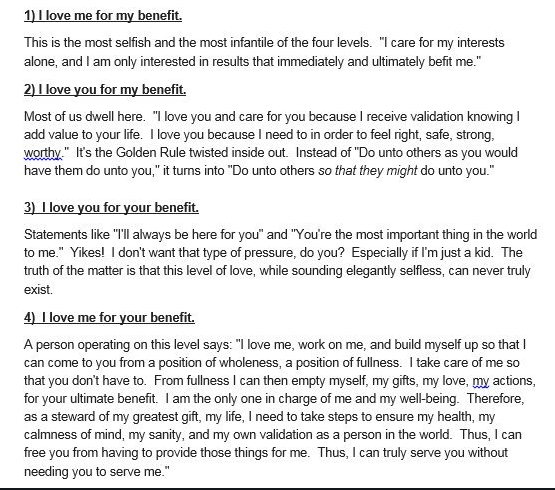
Nate Babcock (@coachnateb) posted this on Twitter. It spoke to me. I enjoy reflecting and this is definitely something I have never saw before nor thought deeply about.

When I look at level one I think of my most basic needs which would be food, air, water, sex, safety. Sometimes I make decisions based solely on those.

Level two reminds me of the I’ll scratch your back if you scratch mine. I am not above this at all. This makes me think of how I interact at school. I will help the custodians, my principal, other teachers, the PTA because I know at some point in time I am going to ask them to help me. This is not the sole reason but if I am being honest it is definitely in the forefront of my mind. If I help them out I expect their help and support in the future. That isn’t the selfless let me help you because you need it; is the let me help you because I know one hand washes the other. There is nothing wrong with that because I believe that is human nature but it is not the selfless love that we will talk about later.

Level three doesn’t exist so I won’t waste my time on it.

Level four is where I would like to spend some time reflecting. My current journey in the constant effort of bettering myself makes me feel that I am working toward level four. I want to better myself so I can serve others. This is why I am learning so much about intersectionality. There are so many people being harmed that I don’t want to add to it. Instead, I would like to be a force that can help stop the pain that is being caused.

Writing that sounds very similar to being a white savior. My aim is not to “save”people. My aim is to understand how people are being harmed in my school and make sure that I am not harming them as well. Not only do I not want to harm them I want to provide a space where if they are being harmed they can heal or escape from that harm while in my safe area.

In order to accomplish that goal I need to learn and understand the system that I am a part of and how it is harming students. I also need to use my privilege and status as a leader to address this harm when I get a chance. I am not “the answer” in my school. I am simply one part of a solution that takes all of us working together to achieve.

I attempt to keep myself healthy by playing basketball and eating as healthy as I can. I am currently in the process of learning about adult executive functioning and how I can improve mine. This is an area that I have always been weak in and I will start addressing it soon.  This will improve my health and ability to serve others.

I am not living at Level Four. I would guess that most people are a variety of levels. My goal in life is to keep level four in the forefront of my mind when making decisions. Is this benefiting me or others? What am I going to gain from making these decisions? Is it the accolades, the pat on the back, the likes or retweets or is it about me being able to help others.

My challenge to myself is how can we continue to grow our love for ourselves in order to better others. What books or podcasts can we learn from? How can we change our eating habits or exercise routines? How can we expand our social networks to make a larger impact? Most importantly how can I love and serve others simply because it is something I value?


Spheres of Influence

Disclaimer. I wrote this blog and did not realize that each section should be it’s own blog. Honestly this should be a book. My apologies.

What is a sphere of influence? The definition that I would like to dissect looks like this: a field or area in which an individual or organization has the power to affect events and developments. (link) Since this is my blog I would like to talk about the individual (myself) and the power I have combined with others to affect events and developments.

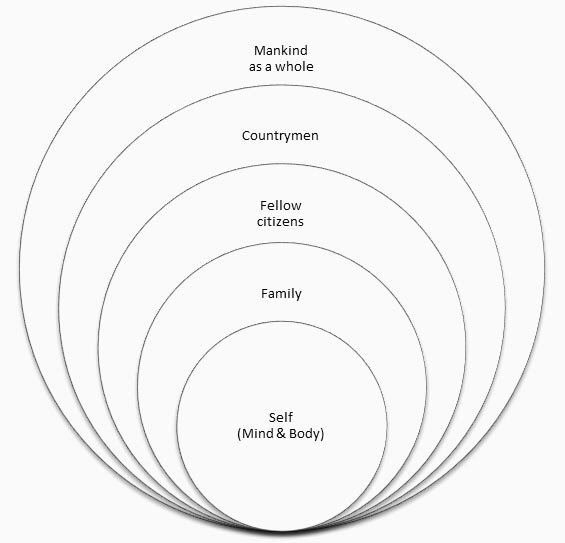
On Twitter the mysterious Sporticus shared this image:

1

We must first focus on ourselves if we wish to make a change in the world. This makes sense. If I am looking to have a positive effect on the world I must understand what that looks like for me. Am I at my best? What am I doing to learn about myself? How am I going about being the best me I can be? Where am I harming people and how can I stop?

The next step is the impact or influence I am having on my family. My job as a parent is to raise children that can understand themselves and the world around them. This means that anti-racism has to be at the forefront of what I have to offer them. In my house we read Rebel Stories for Rebel girls, have a large library full of characters of color, teach the true story of Columbus, the Civil War, Redlining, and every other piece of American history that has contributed to the hate that we have in this country towards our black and brown brothers and sisters. We model and demonstrate support for every marginalized group including the LGBTQIA community, black and brown citizens, as well as our Indigenous people who have been harmed from day one.

I am not even close to understanding the bulk of what my kids need to learn. They will learn with me as I learn. Most importantly I will make sure they see me having relationships with people that don’t look like them. They enter our house and be treated like every other guest we have. I have many more thoughts about this but not the time to continue. You get the gist of how I influence my kids.

The next circles of influence on the image show fellow citizens and countrymen. I would like to combine that for my purposes and change it to people I come in physical contact with. This can be friends, coworkers, and for me my students. What should my impact be on these people? Right now I have three major ideas I would like to impact on others. The first being that movement is essential to a happy well life. The second is that anti-racism is the responsibility of all of us. The final idea is that we need to make every minute the best we possibly can. This means focusing on being positive, enjoying life, and not sweating the small stuff.

How I vote will also affect my fellow citizens and countrymen. Again there is so much more to write I just don’t have the time.

How do I affect mankind as a whole? This is where I believe everything I have stated earlier combined with social media is how I contribute to mankind as a whole. My own children, my students, and the people I come in contact with will all have their spheres of influence. If I am making a positive impact on those around me that has reverberations that will go further than I will ever know.

This brings me to social media. I now have the ability to impact educators from all over the world. I do this through Voxer, Twitter, Youtube and my blog. If I have changed people’s thoughts towards power structures, movement, the need to be anti-racist, the idea that time is fleeting and we need to love one another my sphere of influence can help change mankind toward the better.

Some of you reading may say your ego is so big. You are one person. How can you change the world? I would argue it is not me doing the changing. I have been influenced by others way smarter and better humans than myself. I am just taking what I learned and repackaging it for others. Together the change can occur. I don’t believe that when I die they will write great poems and books of my achievements. What I do know is that I am learning from and with amazing people who all want the world to be a better place. My job is to shine the light on how we can make life better for others.

To finish this rushed blog that should be a book, I want as many people as possible to use what I am doing to make the change where they are. I am using what others are doing to change where I am. There has to be a tipping point where the change impacts the world. Honestly, what do I have to lose in trying?

The “Y” In You

I just started reading a fantastic book called The “Y” In You penned by the loveliest of people Dene Gainey. What stood out from this book is his C.L.I.M.B.E. philosophy. If you would like to purchase Dene’s book click the link below.

Journey to the “Y” in You

C stands for cultivating the quality of the knowledge seeker. Dene talks about creating an environment where his students are able to explore their passion and creativity. In #Physed, I allow this by using inquiry-based learning coupled with a negotiated curriculum. Instead of giving my students the answers I set up the activities so they can figure out their own answers. My questions may look like, “why did that pass not succeed” or “what allowed you to be successful and score that goal”.

One of the favorite thins I like to do is allow my students to either draw a picture, share a doc, or post something on Seesaw that they want to do. This allows me time to make sure i have the equipment and modify the activity based on our needs. For example, if they want to play Nukem and we are working on the overhand throw I might add multiple balls to the activity and have them call out the name of someone on the opposite side of the net before they use the overhand throw to toss them the ball.

L stands for student leadership. We know that students need to learn leadership skills if they are going to be leaders in the workforce. What better way than to give them a taste of leadership in school! One way that I accomplish this is when students create the games they have to explain and modify the game for class. They stand in front of the class and explain the game to them. They field the questions and change anything that doesn’t make sense before we start playing. Speaking in front of your peers is difficult. The earlier we allow them to start the more comfortable they will feel.

I stand for Inspire. My job is to help students see how movement can help their lives. I do this by allowing the students to see how movement will benefit them. I want them to understand that I am not the reason they should move, they are! I tell them that when they get their heart rate up they are creating new brain cells. We talk about movement as a source of social interaction. My goal is for them to want to move because they find value in movement and not because I force them to.

M stands for Motivation.  I provide the motivation for my students. Usually, this comes in the form of you give me 40 minutes and the beginning five minutes of the next class are games you want to play. For those of you who are confused about motivation vs. inspiration here is the difference:

Motivation is comes through imbibing external factors like rewards, gifts etc. Inspiration comes from within! (link)

I motivate by going around and being positive. I motivate by pointing out when students are succeeding. I motivate by hugging a student when they are struggling. My job as a teacher is to use my power to motivate not hate.

B stands for build. Our job is to build students up. As teachers, it is easy to break kids down. We point out their weaknesses, yell at them when they mess up, give them negative consequences when they aren’t compliant or use our power in a number of detrimental ways. I choose to build my students up. I tell my students of color how handsome or beautiful they are, comment on how I love their natural hair, and ask them if they have looked in the mirror and told themselves how awesome they are.

I am a non-tested area. That means that I can focus more on the affective than the cognitive. Don’t get me wrong. I am a teacher of content that I expect them to learn and master skills but that is secondary to them feeling good about themselves. I focus on making them laugh, pointing out their successes, and explaining how the students that may be physically ahead of them practice that skill outside of class on a soccer team, basketball team, or baseball team. I am there to lift up my students. I am creating self-fulfilling prophecies that will allow them to succeed now and in the future. If I had to choose my favorite letter of this chapter B would be it Fo Sho!

E stands for Enrich/Empower. The main way I do this is by introducing iterations to my gameplay. I will present activities. We play a bunch of rounds with me changing the rules, equipment, distance, or teams. My final builds/iterations are left open to the class. They vote on the rule changes that they come up with. This allows the students to feel that they have a say in the class. In all honesty, their rules are usually better than mine. They come up with twists that make me wonder why I didn’t think of that!

When we allow our students to take control of the activity we are empowering them. They are using the 4 C’s. If we really want thinkers we have to give the students the opportunity to think! Too often we spoon feed them because that is easier for us. The class runs smoother. There are fewer arguments. What we are doing is thinking for them though. That is a problem.

I would highly recommend reading The “Y” In You. This was only one chapter of the book that I broke down!! Think about everything else that we didn’t learn about! As always join our Voxer group if you want to continued the conversation further.

I would like to thank Dene Gainey for being awesome!


Laughter is the Best Medicine

Normally my blog focuses on a weakness that I have or problems that I see in the world. To be honest it gets tiring focusing on the negative all the time. It’s a battle that I need to step away from time to time. Today I want to focus on a strength that I have and that I imagine most of you have. That strength is the ability to make people laugh.

I remember the first time I recognized that my words and actions could make people laugh. We were eating dinner as a family when I told my parents a funny anecdote that happened at school. The sound of their laughter gave me a feeling that can only be described as euphoria. Looking back that was the moment that I understood why comedians chased this for a living.

I look to make people laugh wherever I go. There are some go-to jokes that are always sure to work. I will share them with you in the hopes that you too can bring happiness to those around you. My first couple of guaranteed laughs occur at the grocery store. When you get lunch meat tell the person behind the counter that you want a pound of meat or cheese. If it is over .01 or more tell them you want the piece removed; pause for a second before you start laughing. Believe it or not people are serious about this and the person behind the deli counter will chuckle guaranteed. My second laugh is when you are being rung up at the register announce loudly that the person behind you said they will pay for your groceries. This brings a smile to everyone’s face.

My favorite go-to humor with little kids is to shake their hand and not let go. I pretend to walk away all the while grasping their hand tightly and shaking it. I loudly state that I need to go and to stop fooling around. This makes even the most stoic child giggle. Another classic that most of you probably know is the high five where you yell in pain when they slap your hand too hard. For some reason, children love this and try to hit your hand harder laughing gleefully as they attempt to inflict pain upon you.

If you want one that crosses over for any age go with the fake fart. One of my favorite stories was the first time I met Judy Lobianco. Warning DO NOT DO THIS TO YOUR BOSS! We were at a large physed convention and I saw her eating breakfast. I stealthily snuck up behind her and placed my blue tooth speaker behind her chair. The next step is where the genius occurred. I connected my phone to the speaker and went to a youtube playlist of fart sounds. It took Judy a couple of seconds to figure out.  Luckily Jlo thought it was hilarious!! Fake farts work for people of all ages. They are the cheese of jokes.

Now to the part where I tie all this into education. Your teaching area needs a space for people to feel comfortable. Laughter is one way to achieve this. It breaks the ice, lowers stress levels, helps bond groups together, and creates a space where people want to be. Laughter transcends race, gender, language, and culture. I can write about laughter forever but to be honest, it’s not funny to read about it.

I will leave you with one last video. This was my introduction at the Colonial Tech Conference. I used physical humor to elicit laughter and bring people to my session. I want you to watch @techedupteacher (Chris Aviles) in the beginning. He either gets the joke or is one unempathetic dude!!

How do you use laughter in your class?

Florida

Walking home from school the minute I saw the white Crown Victoria parked in front of my parent’s house shrieks of delight would erupt from my throat. This meant that my grandparents had driven up from Florida. My grandparents were the type of people that kids dream about. They were always down to go to the playground, go camping, take us on a vacation, and most importantly there were always chocolate Entenmann’s donuts in the freezer.

I have the fondest memories of playing basketball, riding bikes, and playing cards with them. Today I play the card game 99 with my own children and summer campers. Driving in the car was always a game. We would name countries taking turns starting the next country’s name with the final letter of the previous country. Maybe we would try to find license plates from every state or would get tested on our multiplication facts. As you can tell I come from a family of educators.

I was 11 when my grandmother died of lung cancer through no action of her own. (meaning she never smoked) I tell you all this to set the stage for this weekend. My grandfather just turned 90. He currently resides in Florida so I hopped on a plane to celebrate with him. It was a surprise so he was really excited when I knocked on his door and gave him the biggest hug. We talked and hung out, listened to some old rock and big band music, and ate lunch. The conversation then turned to my grandmother. For some background information, my grandparents had met when they were 13 and lived in New York City. They were the only people they dated and got married when they were 21.

Zaida: (what I call him) Your grandmother loved being with you and your brother.

Me: Tell me the story again about how she rationed her kisses with you. (My favorite story of all time)

Zaida: We both didn’t know anything about sex. Your Nonna (what I call grandmother) and I were both young and Nonna thought you could get pregnant by kissing too much. We went to the store and bought a biology book and learned about sex that way.

Me: I remember how difficult it was when she got sick. I didn’t really understand what was going on and it was hard when she wasn’t able to play with us like she used to.

Zaida: Yes those were two hard long years.

Me: Was she scared of dying?

Zaida: She was so strong during the cancer treatments. She always thought she was going to beat it. She never cried or complained. We would rent a hotel room near the cancer treatments and watch Broadway shows on TV pretending that we were on vacation. One time after she received the news that the treatment wasn’t going as planned she stated she didn’t want to die. I told her we are all living creatures and will die eventually. That was the only time she ever said anything about it.

Later that evening I asked him what he thought about death. Did he think he was ever going to see my grandmother again? He replied:

“I am fatalistic about death. There is no use in thinking about it because we don’t know and when we get there we will understand what’s going on. I hope to see her again but I don’t know.”

We went on to talk about life after my grandma died, watched videos of his wedding, and old family videos. It was great seeing him come alive and telling me who these strange people were that I was related to.

These conversations are so important to have. I loved asking these questions and listening to his responses. I have read Tuesdays with Morrie and all the Chicken Soup books. I didn’t want to let an opportunity to pass where I can have authentic conversations with my grandfather. After all, he is 90 how many more of these will we be able to have!

This blog has no educational relevance. Hopefully, it will help you think about the relationships and conversations with your family and friends.

RageQuit

This week for my K-2 students I set up a game where the students had partners. One partner was to stand in a hula hoop holding half of a pool noodle. In the front, back, left and right of the hula hoop a domed cone was placed. The idea of the game was that the defenders were to tag anyone who tried to steal a domed cone from them. Their partner was simultaneously attempting to steal the domed cones from other hoops. If the stole a cone they bring it back to their hoop. If they got tagged they had to touch a wall and attack another hoop. I did not make up the game. To see my lesson plan click here.

During the game, I had a student who happens to play about 60 hours a week of Roblox get upset and stop playing. I asked him why he wasn’t playing and he told me he RageQuit.  I had to look that up. RageQuit: To stop playing a game out of an anger towards an event that transpired within the game. (Link) This idea of RageQuit is interesting. In video games, you can just turn the game off when you get mad. In PhysEd when you quit you are voiding the social contract that you made with your class. RageQuitting affects your classmates and the game.

If my students get upset they can walk on the outside of the gym at any time. That is a release that I purposefully set up. When they are walking there it shows me that there is a problem. They can then either return to the game when they are ready or come talk to me about what the issue is. If they reach that point I have missed an opportunity to step in though.

My goal as a teacher is to intervene before I have a student RageQuit. I want to notice the signs and approach the student and ask why they are frustrated. Sometimes the solution of Rock, Paper, and Scissors does wonders. Other times we work on breathing and other mindfulness techniques. We may have the conversation about big problems and little problems. Whatever the deal is the important part is that as teachers we need to intervene and de-escalate before it is time to RageQuit.

Some may call it grit, resilience, or perseverance. Whatever you call helping our students understand how to deal with their frustration and anger is a major part of our jobs. This may not be located directly in the standards or written as an objective in your plans but it may be the most important thing we teach our students. How do you deal with the anger when it arises? How can we take the feeling of frustration and allow it to dissipate? That is one piece of why teaching is an art, not a science. Each child will need different de-escalation techniques.

An example of this happened on Friday. A student with special needs was upset because I started our Movement Math class in a classroom. It was always in the gym before that. I knew he had struggled the previous day. I walked into his class and he started yelling and threw himself on the floor. I was able to discern that he was upset about the change (some students are good at change). I explained we would start in the class and roll into the gym halfway through the period. He told me he needed some time. I asked how much. He stated he needed ten minutes. I told him ten minutes was fine but if he wasn’t where he needed to be in ten there would be consequences.

I left his class and rejoined the main class that was beginning their movement math project. Ten minutes later this student rolled in ready to join us. If I had gone toe to toe on a power trip I would have ended up restraining the child. Instead, I used de-escalation and was able to get him to join for 35 of the 45 minutes avoiding the RageQuit.

My point of this blog is to let you understand that our students have a threshold of anger or frustration that they are willing to accept. If that threshold is exceeded they may go into a RageQuit. We need to understand our students and step in before this happens.


4th Grade Doesn’t Hold Back

You ever have trouble with your curriculum? Ever taught a semester and looked back and know it just didn’t work? That is how my 4th Grade Health went this year. I struggle with 4th Grade Health for some reason. My lessons are flat and just not as engaging as they should be. How do I know this? I asked. Here is just one section of the responses:

1

I then asked the class to brainstorm how we can make the class better. Here is what we came up with:

2

I run professional development on how to be engaging in the classroom and here I was ignoring what I have told countless other teachers to do!

My lessons are clearly stale. This coupled with the lack of movement is a killer. I am going to reach out to my health Voxer group and find out how they teach vitamins and minerals. The content has to be delivered in a better fashion!

It was disheartening to read their responses but on some level I knew that I need to step up my health game in 4th grade. I am glad I asked my students this question or I would have ignored a major weakness in my teaching. I now need to go back and use this information to improve my craft.

How do you get feedback on your teaching?

This is Water

I wake up tired from basketball the night before or maybe it’s my second job that brings me home around the same time the big hand hits the six and the little hand is halfway between the ten and eleven. It could be the blog I wrote that kept me up later than I had anticipated or perhaps an interview with the Voxcast went longer than expected. It doesn’t matter. The kids still need to get dressed, eat, and have their teeth brushed. Book bags need to be packed and we have to be out the door by 8:15.

I hop in the car and stop by Wawa (coffe shop). Coffee is a must. The hot liquid hits my lip and slowly I start to wake up. I walk into school haltingly. Each step forcing myself to professionally start my day. Then it happens. My eyes meet a student’s. The switch is flipped. I automatically let out a wzuuuuuup not letting them know just how tired I really am. Their face lights up. They were acknowledged. They were loved. I follow up my greeting with a fist bump or ask if they want a hug. I may question them about their weekend, their sports game, their sibling or one of a thousand other connection building questions. They answer and walk away ready to start their day knowing I care about them.

I stop in the office and sign in. I say hello to the secretaries and go behind one of them and shake her chair yelling earthquake. (That never gets old.) I pop my head in to my boss say hello and quickly make my way out before I get yelled at or asked to cover a class!

I walk by one of my favorite aids and greet her with a simple word: duty. We both laugh at the hilarity of the word and our childish humor. (I stole this from her other friend who does the same thing to her. I can appreciate good humor even if I am not the creator.) Laughter helps.

I continue down the hallway. Smiling and saying hello to every person I see whether they are young or old.  Whether I have positive or negative emotions attached to the person of child I do not let it show.

I choose to ignore the exhaustion, the worry about my brother, or the stress of my parents unhappiness with me. I force myself to be positive in the present. There will always be problems. Someone will always be unhappy with what I am doing. That’s life. I won’t let my students see my struggle. They deserve the best version I can conjure of myself.

The bell rings. The day is ready to begin.

Watch this video. It does a really good job of helping to explain my mindset. I know him calling the lady fat is wrong. The rest of the message is amazing.

This is Water-David Foster Wallace from alexander correll on Vimeo.


David vs. Goliath (Local vs. SHAPE)

This week SHAPE America had their annual conference. There were close to 3500 attendees who attended the attractive Nashville, TN destination. I would imagine the conference costs easily in the six digit figure. Keynote speakers were flown in, socials were planned, and some of the best and brightest Physical Education and Health teachers shared their immense knowledge and skills with each other. All the major companies brought their best presenters, paid for socials, and gave away free equipment to participants.  I am sure it was amazing.

During this same time, Sean Pasieka (@seanpasieka) held a Physical Education conference with 20 attendants. Attendants were asked to email their best lesson and present them to a group of 18 3rd graders who were willing participants for either the morning or afternoon.  These presenters may have never presented in front of anyone before. They may or may not have been well versed in GLO’s, standard-based grading, or what many consider best practices.  What the attendees lacked in knowledge or experience they made up with by dedicating their day to getting better. They were able to see 15 different lesson ideas, 15 different ways to interact with students, and 15 different ways to present a topic.

This final period of the day every teacher was asked to show one instant activity or tag game. This was a simple demo slam of quick hitting ideas. I loved this idea!

The irony was not lost on me that while the most coveted Physical Education conference in the United States was being held in Nashville a tiny little conference was being held in Kinnelon Nj. The dichotomy could not have been greater. They were polar opposites in terms of cost, attendants, prestige, the vetting process, social media awareness, and pomp/circumstance.

It also occurred to me that both have their place in the world of professional development. We need the big conferences to share the newest ideas, best practices, and newest research. We also need these tiny conferences to keep the fire alive. It gives newer presenters an opportunity to present as well as older ones the opportunity to continue to give back. These small teach meets, pe jams, or mini-conferences are valuable assets that are underutilized.

What are your thoughts?

Physical Activity, Fitness, Academic Achievement, Academic Performance

Dr. Aaron Beighle hit me up on Voxer to discuss my blog titled The True Argument for Physical Education. He gave me some pushback on my loose verbiage. He went on to post his thoughts here on his vlog (video blog).

I have dictated his vlog for your viewing pleasure:

I want to provide a few very brief definitions. I want to talk about the physical activity as a behavior. It’s just any physical activity or any movement we do. I think we often confuse this with fitness.  Fitness is an outcome. Fitness is how well you do on a battery of tests or an individual test but it’s not the same thing as physical activity. Physical activity if it’s done as exercise can improve fitness, but fitness and physical activity are not the same thing.

Academic achievement is just basically standardized test performance. Academic performances are behavior, attendance, attention span, there are all kinds of things that influence academic performance.

I think where we get in trouble is we start focusing on fitness and academic achievement. As a rationale for physical education existing. Which I think physical education exists because we offer something unique that no one else does. But, fitness is something that’s controlled primarily by genetics and maturation. Frankly, some people will never decide to be fit; but, they can be healthy because the health comes from being physically active. We have to keep going back to that. We want kids to be active because the data is pretty clear the data on fitness and academic achievement is correlation and not overly strong.

What is strong is the data on physical activity and academic performance.  We know attention span goes up when they are active and behavior problems go down when they are active.  Those are two often cited barriers. As physical educators, we can improve and help foster physical activity. It’s really hard to foster and promote fitness, I think we have to be very careful on that. Fitness has its place. I’m not saying that fitness doesn’t have a part of this. I think some will choose to be fit some won’t. We have to focus on physical activity because that’s where the health comes from.

You should check out the book No Sweat by Michele Segar. It’s a fabulous book that shows we have some issues with how we do fitness. We probably aren’t doing it the right way. We are not using the right motivation or helping people find meaning in physical activity.

We need to focus on physical education. It stands on its own for the potential that we have for impacting the health and physical literacy journey for students. It also has physical activity benefits so promotoing physical activity (first) and then… there is also these cognitive benefits as well that are academic benefits as well. We need to be careful about tying in fitness and saying if they do better on fitness tests they will do better academciall. Its a slippery slope and I dont know if we have all the data in yet.

Dr. Aaron Beighle

That is a brilliant bit of work right there! The argument isn’t about fitness at all. It’s about movement. This ties in brilliantly to Dr. Oconnor’s latest post titled Teaching Movement for Understanding. We have to go back to the idea of movement as fun and enjoyable. Everything stems from there. Physical Education teaches and encourages physical activity first and foremost. Are there additional benefits in academic behaviors? Absolutely! That is not something we should hang our hat on though.

With that being said, it is a bargaining chip to be used in a system that undervalues us. If we were building a boat the academic benefits would be a decorative bow on the side somewhere. We make the case that students health is more important than test scores. If we focus on that and don’t let the test score pendulum scare us we will be pointed in the right direction as a profession.

P.S. Don’t allow standardized testing in our profession either!

What can you add to this conversation? Tweet @AaronBeighle @Schleiderjustin @JustenO’connor