Category Archives: education

Mush Face

As many of you know there are not many things that I enjoy more than playing basketball. It brings me a joy that very few things are able to. When I am in the gym the world disappears for 2 hours. The worries and stresses of my life slip away and for a while, the only thing that matters is playing. On the days I play I look forward to it as soon as I wake up and that feeling of excitement continues all day until it is time to play. I rearrange Voxcasts and family affairs in order to participate! When it gets canceled I go into a funk that is only rivaled by losing money. The funniest part of my love for basketball is that I am not even that good at it. I have a mediocre shot, am 1/2 inch shy of six foot, and my handle is barely competent on a good day. Let me put it this way, I wouldn’t start on most JV high school teams. My only saving grace is I am somewhat athletic and can usually place myself in the best position to succeed.

Twice a week I go to the local high school and play what I call “old man” basketball. A bunch of older (20’s and 30’s) guys get together and play pickup games. We call our own fouls and rarely ever argue. I break the teams up evenly and we rotate the teams in and out so winning does not dictate whether you get to play again or not. The culture and climate that has been created is amazing. Overall it is a movement paradise!

This week the local high school was closed so I went to a local gym to play a pickup game. The average age of participants was 20 years of age and I was easily the oldest person there at the age of 35. We picked the teams and started to play. There was an argument on almost every play whether there was a foul or who the ball was out on. I suddenly remembered why I hate playing at the park or outside of my old man league. It was brutal to watch time and energy being wasted on arguing over a call.

One of the players was around 21 and was a 1,000 point scorer in high school. He was the best player on the court by far. He was hitting 3’s and was dribbling by everyone with ease. One play the ball was in the air and I went to box him out. Next thing I know I feel his hand on my face pushing my head followed by the statement, “I will do that every time you box out with your arms. That is some p*&%y s*$t.” Let me preface that by saying I had never known the way I boxed out was a foul. I wrestled my whole life and basketball was something I did for fun. I never played in a league or played with refs. I am not saying what I did was not wrong I just had never had anyone say anything before.

Back to getting my face mushed. I felt humiliated and it immediately took me out of the game. I didn’t move at all for the rest of the game and quickly went home as soon as the game was over. The incident stuck with me all week. I replayed it over and over again sometimes imagining a different reaction and what the outcome would be. I do this often with situations when I feel upset. I pay different scenarios in my head of how I could have handled it and what the repercussions would be. Sort of like a poor man’s Walter Mitty. 

It reminded me of a time in class when a child purposefully threw the ball off of another child’s face so it would bounce back to him. I knew that feeling the child on the receiving end of the ball felt exactly. The humiliation. The loss of pride and power. The knowledge that any recourse taken would only lead to either physical harm or other consequences.  When this happened to me as an adult I recognized that this was a situation I needed to leave immediately. My student in class did not have that same luxury. They had to stay there and deal with their feelings of inadequacy in the public light of my class.

The incident bothered me greatly. I did a lot of mindful breathing and rationalize to myself why what happened wasn’t as big of a deal as I was making it out to be. It was one incident that really didn’t impact my life in any giant measurable way. Either way, it was nipping at me all week.

There are a couple of thoughts I have about my situation. First; when someone disrespects another in a game they are taking the joy away from them. They are not unlike the Grinch who wanted to steal the joy of Christmas from the Who’s. As a teacher, this is something we need to be aware of. This loss of joy not only affects our students at that moment they are going to feel a sense of shame or anger whenever they are reminded of the incident.  It will create a negative association that can last forever. We must ensure that the climate and culture we set in our class does not allow this to occur. Conflict will arise and that is unavoidable; however, it is necessary that it is not elevated to a place where students lose their self-respect and joy of movement.

Secondly, Jorge Rodriguez says that when we play a game we need our opponents to want to play with us again. This takes teaching games to a whole other level. We aren’t just teaching the game but socialization. Who wants to play a game with people that make us feel like garbage? In my situation, I will not be playing basketball at this gym or with that person again. I lost a place to enjoy movement and that sucks.

My final thought is what we can do when this does occur in our class. In the situation, with the aggressor in my class, I spoke to him privately as well as with their parent and an administrator. I made it known that my class will not be a place where students will experience either physical or psychological harm.

Have you ever experienced something similar to me? How did you handle the loss of pride and joy?
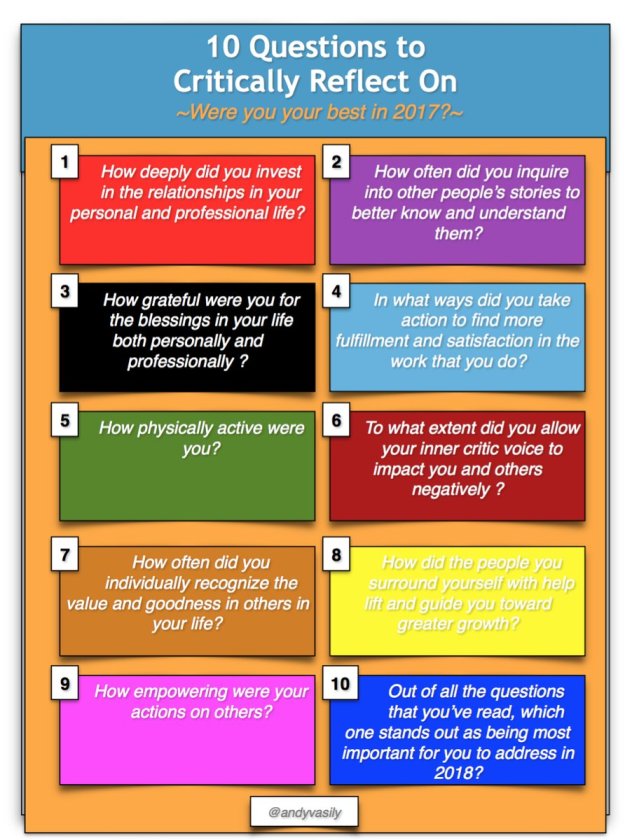


10 Questions to Critically Reflect On


andy vasily

This image was created by Andy Vasily.  It will help guide my 2017 reflection.

  1.  I have deepened many personal and professional relationships this year. I strengthened many of my professional relationships at the SHAPE National Convention this year. Sleeping Rooming with Andy Milne was a highlight for sure! Coming in a close second was hanging with my Paddle Zlam crew! Meeting Mel Hamada and Shrehan Lynch in person cannot be overlooked as well. I could spend pages just reflecting on that experience alone. I have also combined some of my professional relationships into much more personal relationships. Getting to know people on a deeper level was definitely a goal for me this year.
  2. I am always interested in people’s stories for sure. I firmly believe that everyone has a story and I can learn from everyone. We have interviewed many people on the Voxcast which allows people to have a platform to center and amplify their voices.
  3. This year I was very grateful for my personal blessings. My family is overall very healthy and I acknowledge and appreciate this. Professionally I haven’t counted my blessings. I sometimes feel stuck in a rut and don’t know what to do about it. Hopefully, 2018 will help me with this feeling.
  4. This past year I have written a book chapter and numerous blogs, created some cool Voxcasts, presented locally, regionally, and nationally. In the classroom, I have really continued to work on having a more student-centered approach. I am happy with my progress and have some really cool ideas for a future Voxer book club podcast and helping Kennedra Tucker with a social justice podcast.
  5. Physically this year was a let down for me. I played basketball twice a week but I have slacked on my muscular endurance and strength training. I need to get back on track.
  6. My inner critic voice kept me back from applying for some jobs. I have also apologized more this year for the words that have left my mouth than in years past.
  7. I have spent more time trying to recognize others value and goodness in my life. This occurred in many fashions. Some people received gifts from me, others a card, and still others I made time for.
  8. I surround myself with great people who push themselves so hard that I can only marvel at what they do. This helps drive me to continue to be a creator and producer in a world of consumption.
  9. I don’t know how much I empowered others. I do know that if anyone asks me for help I did anything and everything in my power to assist and empower them.
  10. In 2018 I  will work on being more physically active. The value of this can’t be overstated.

Take the @andyvasily reflection challenge. What did your year look like?


How Actions are Perceived

Every trimester I give out a feedback form to my students. I truly want to learn what how they feel about my class. More importantly, I want to find out what their perception of me is. One of the questions I ask them is, “How much do you feel Mr. S. likes you?” I was surprised by one student who marked down that I dislike them. First off this student is a very good student who makes minor behavioral decisions that I disagree with. I honestly like this child. They are not reprimanded very often nor have they ever received a poor mark in my class.

If all that is true above, why does that child believe I dislike them? I honestly don’t know but I will be finding out soon. What is interesting here is the idea that my actions toward him may not be showing him how I truly feel about him. How often does this happen with my other students? What about other adults? This conversation was brought up in the restorative justice group on Voxer. How often are our words and actions being interpreted in a different manner than what we were intending?

I look forward to finding out the feedback the rest of my students give me. The important part of this whole process is that I have to use this information to change my teaching. If you hold power over a person or group of people it is your duty to find out what they think of you and your job. How many administrators poll their teachers? How many teachers poll their students? If we care about our students shouldn’t we find out how they truly feel about us and our class? How else will we get better?

trimester questions


100 Word Challenge

Today I read Dene Gainey’s  (@dene_gainey) blog titled What Are My 100 Words? The premise behind the blog was that you had to write 100 words on why you love teaching. The idea came about when Jesse Boyce (@Jessxbo) was given the assignment as part of her Teacher of the Year candidacy. She wrote:

“I get to show students the beauty in struggle and the power of making mistakes.  Math is a topic that makes most people cringe and I feel fortunate to get to make it something that is less scary.  I love to show my students that something that seems impossible does not have to be that way, but can be fun! I love showing them that the struggles that occur in math are paralleled to life; that there is always a way.  I teach compassion, how to be good people, how to love, how to see a different point of view.” (link)

This is a powerful statement! I try not to compare myself to others by telling myself that my writing is more about the thought than the execution; however, this was both well thought out and executed. Here is Dene’s 100 words:

“I love teaching because it is a perpetual process of learning & I am just as much of a student when I teach as the students themselves are. I love teaching because of the immense ability to “reach” and not just teach & to see lives transformed through that reach! I love teaching because little by little, the world can be changed for the better. I love teaching because of spontaneous discovery and the ability to empower students to C.L.I.M.B.E. There is nothing more beautiful than seeing students actualize themselves and take ownership and independence when learning.” (link)

Dene’s idea that the world can be changed by us is spot on. He fit so much into so little of a space. This is going to be difficult. Ok, I just wrote it and it took me 45 minutes. Here is the result:

Teaching is sharing time with people. Every day I get the opportunity to provide a safe environment for kids to explore and have fun. We form connections and memories that will leave a lasting impression on all parties. Together we enjoy creating new neural connections constantly challenging ourselves to grow. I get to feel that I am impacting the world battling hate and fear. Future generations will be changed for the better if I continuously grow and make a positive impact on my students. I am leaving the world a better place than before I got there.

Go ahead. Take the challenge that Jessie Boyce laid down. Write your 100 Words on Why You Love Teaching than tag @jessxbo, @dene_gainey, and @schleiderjustin. I can’t wait to read why you love to teach!

Parent Teacher Conferences and Seesaw

Disclosure: I am a Seesaw ambassador. That means I get more classes to use for free.

The past couple of years I have had more parent conferences than ever before. They are mostly with my younger students. Their parents want to know how their child is doing in my class which is completely reasonable and should be lauded. I always tell the parents that if there was an issue with their child they would have heard from me well before the middle or end of November but I digress.

What I did notice with the meetings was that I felt a comfort level during those meetings that I hadn’t felt when I was first teaching. Some of that could be explained by my increasing knowledge of my subject area and the fact that my community knows me very well after 7 years. That is only part of the answer though.

The biggest factor in my opinion is my use of Seesaw. Every single meeting the parent commented how much they  enjoyed the videos. This gave them a knowledge of what my class is about as well as a comfort level with me. That cannot be valued enough! The conversations were pleasant and productive.

One parent told me they sit with their child and watch the videos together. They than ask them questions about what is going on in the video, did they have fun, and what were they learning. This made my year to hear that. There is nothing more powerful than enabling a family to have a window into my class that starts a conversation about learning and joy.

If you aren’t using Seesaw you are missing out.


EdCampNJ 2017

Thanksgiving is this Thursday. That means that another EdCampNJ was held on Saturday at New Brunswick High School. One of the reasons I was so excited about it was to see if our mission of reaching out to New Jersey and New York educators of color was going to make a difference. To paraphrase the great Maha Bali educators of color need to not only be invited to the table, they need to make the table and set the table. It was clear that our organizing team reflected the mission of EdCampNJ. Would the crowd be the same?

The answer was an overwhelming yes! With the help of Newark Public School, EdCamp Brooklyn, EdCamp Urban, and word of mouth the crowd was filled with a beautiful mix of people. We accurately reflected the rainbow of teachers that teach the students in the great state of New Jersey.

I personally spent the day in lovely room G 108. The NJ AHPERD was kind enough to lend us the Revo Labs UC 1500Revo Labs UC 1500. This allowed us to mic the room up so we had people from Texas, Las Vegas, Qatar, and Arizona join us via audio and video.

The first session held in the room was Social Justice. The conversations were amazing. We were able to honestly speak about race in an environment that was supportive and encouraging. I personally enjoyed the discussion when someone says they don’t see race. The gold nugget from this session was when Cory Radisch stated that some teachers are punishing their students for their disabilities. I was a tad upset that we did not utilize an LGBTQIA expert in the room or address intersectionality. I would highly encourage everyone to watch or listen to the session here. The session notes are also attached at the bottom of the video.

The second session was all about Tech Tools. This was a cool session because it was more like a demo slam. Everyone in the room was able to talk about any tech tools they wanted. There were definitely some experts in the room who chimed in a lot but that was needed because others in the room were there to hear about some of the newest tools available. I would highly recommend you check out the session notes or watch the video by clicking here.

The third session titled Social Emotional Learning was facilitated by @Bond007Laura (Laura Bond). We talked all about the whole child and also how we sometimes forget the teacher needs to take care of themselves as well. Lavonna Roth’s new Ignite Your Shine lessons were being lauded to the room. I would recommend checking out the notes and either watching or listening to the session by clicking here

The final session was run by Josue Falaise. The session was all about PLC’s. What I found interesting is how well Josue was able to handle the room. There were a ton of people there but not many knew or wanted to talk about PLC’s he had to do most of the heavy lifting during the conversation. He was able to answer questions and give everyone an idea of what PLC’s should look like. My gold nuggets from this session were the idea that PLC’s should revolve around solving a problem and that there need to be norms created and followed. Brian Costello told a hilarious story about how everyone has yarn balls and if the meeting starts to go sideways they have a quick indoor snowball fight than they get back on track. Check out his session here.

As always I have a list of grows and glows for the (un)conference.

Glow: Bibiana Prada @bookgirl614 ran a great EdCamp 101 three times before session 1.

Glow: New Brunswick High School. The internet was awesome and so was the facility and parking.

Glow and Groan: The prizes were numerous. There was a line at the end to receive them that held a lot of people up.

Grow: There was no real ending to the day.

Glow: Dan Borghoff and Meredith Martin doing their maker thing.

Glow: The diversity of the crowd.

Overall the day was a huge success for the participants. I only heard great things about the day and really felt like educators were able to learn about a variety of subjects. If you attended I would love to hear your thoughts!!

WhiteBoards

Sherri Spelic recently wrote this blog post about whiteboards. I agree with her that projectors and whiteboards are fantastic tools that are essential in the gym

stock-photo-empty-whiteboard-magnetic-board-isolated-on-white-208699177or the classroom. I use mine and find it an awesome teaching tool.
I would like to talk about the other whiteboards though. The ones that look like the image on the left. These whiteboards are quickly becoming one of my favorite forms of assessments.

My parents are always complaining that I use too much technology in my class. I poll my students often for feedback and they universally agreed this was true. The turning point for me was that the students said they would rather use paper and pencil for their reflections than using their Chromebooks. Using their feedback to change my teaching practice forced me to figure out new ways to have them reflect without technology. Hence the personal whiteboards.

My students will be given multiple tasks to do in class. One of them is to grab the whiteboard and answer some sort of reflection question. They write their name on the bottom and put the whiteboards on the side of the gym. I then take a picture of each whiteboard and upload it to their Seesaw account. This allows me to have evidence of their learning as well as continuing to inform their guardians about what we are learning in class. This has cut down on the amount of time that students are on technology during my class.

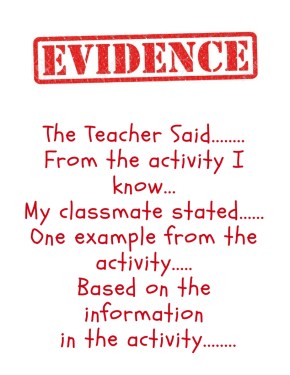
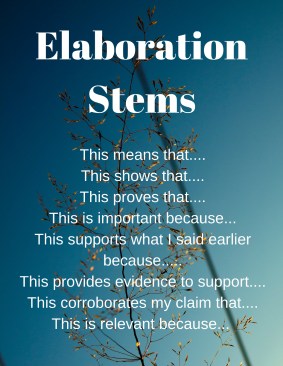
A fourth-grade teacher commented on how he liked this idea and gave me some information about evidence and elaboration stems. I created these two posters and display them using my projector.

Evidence Stems Elaboration Stems.jpg


As with everything else in my teaching. I will continue to tweak this and use the feedback from my students to improve their experience in my class. If you do anything similar please share with me on Facebook or Twitter!

Social Justice “Miseducation” In Our Schools

This blog post is a response to the article Social Justice Miseducation In Our Schools written by J. Martin Rochester who is a professor of political science at the University of Missouri-St. Louis.

Mr. Rochester starts out his article by stating:

As I wrote in my book, Class Warfare “there has always been the temptation to use schools for purposes other than schooling, for proselytizing and other ends, since children are the ultimate captive audience.”

I would argue that not only has there been the temptation it has occurred since the inception of schools. We have taught our students a false narrative about Christopher Columbus, Thanksgiving, the Civil War, patriotism, and a multitude of other subjects. We haven’t just “stuck to the facts” because history has always been told through the eyes of the victors. The facts we use to teach are biased.

Mr. Rochester goes on to state:

First, schools should mainly stick to what they are uniquely entrusted to do—teaching math, physics, English, and other subject matter and, beyond that, a love of learning. Schools should not aspire to be churches or social work agencies. In an already overcrowded school day in which our schools struggle to find the time to get students to become proficient in “the three R’s,” social justice training can be a huge distraction.

Schools are not entrusted to just teach the cognitive piece of the child nor should they be. One of the aims of schools is to produce well-rounded citizens. To ignore the affective part of the child is a mistake that far too many teachers and administrators have made. It is one of the main reasons that students hate school and don’t identify with the material that is provided for them. This idea of just the facts is why testing is out of control right now.

In addition to the social and emotional part of the child, we return to that same pesky idea that what is being taught in schools now is already highly biased toward the white majority of the country. Why else do we have arguments that the Civil War was fought over state’s rights or ignore how the War on Drugs was really a war on urban youth? The idea that teachers need to stay in their lane is how we continue to hide the troubled history of our country.

J. Martin Rochester believes, “It is sheer hubris for teachers to bring their own personal political agenda into the classroom. What happened to free inquiry?” He goes on to state that he brings in a broad range of views from right to left in his class. Teaching facts is not a political agenda. Teaching our students that the indigenous people of our country were murdered time and time again breaking numerous treaties and agreements is not a political agenda any more than stating 2 plus 2 equals 4. In a world of “alternative facts” (lies) we can no longer allow school systems to lie to our students. This is not a right or left issue. It’s a lie vs truth issue. We need to stop lying to our students.

I am all about the students finding their own path toward truth but only providing the whitewashed information that our public schools currently do is a travesty of education for our Students of Color.

Here is where things get really interesting.

Educators for Social Justice talk a lot about diversity, but do they promote the most important type of diversity—diversity of ideas? Contrary to their claim that they celebrate “disagreement,” they seem to promote only a politically correct, left-leaning perspective. What are the chances they would have their students read analyses about poverty and race written by conservative writers such as Charles Murray (Coming Apart), Thomas Sowell (Wealth, Poverty, and Politics), and Walter Williams (Race and Economics) or—relating to the Stockley verdict and policing—the scholarly work of Heather MacDonald (The War on Cops), which shows “systemic police brutality” to be a false narrative?

I agree with the author here. We should always present multiple sides to an argument. This is where critical thinking has to be taught.  Students need to see what the counter-arguments to their thoughts are. Some may have validity others may not. Either way, you need to know all the facts before you make up your mind. Right now the facts presented to us are not diverse nor do they encourage critically viewing the actions of our country in the past.

This brings up the point of how we present all the sides of a discussion now in schools. The author must think we do this well because he writes this:

Educators for Social Justice are disingenuous in posing as facilitators of student-centered learning, when as teachers they have largely foreclosed the discussion or at least steered it toward a preferred outcome.

Right now I can say that 99% of teachers are doing this on the opposite end of the spectrum. How many teachers will be talking about what really happened during Thanksgiving and what happened directly after it? Where is the talk about institutional racism? We talk about the Civil War and Jim Crow laws and act like everything post-1954 was all good. These discussions aren’t being had in our classes. We have sanitized Dr. King’s work. Do we ever mention how he stated this:

“Urban riots must now be recognized as durable social phenomena,” he told the assembled crowd of mostly white doctors and academics. “They may be deplored, but they are there and should be understood. Urban riots are a special form of violence. They are not insurrections. The rioters are not seeking to seize territory or to attain control of institutions. They are mainly intended to shock the white community. They are a distorted form of social protest. The looting which is their principal feature serves many functions. It enables the most enraged and deprived Negro to take hold of consumer goods with the ease the white man does by using his purse. Often the Negro does not even want what he takes; he wants the experience of taking.” (link)

That is steering our student’s learning towards a preferred outcome.

Mr. Rochester finished his article up with the most asinine argument ever:

I would argue that, if you want to teach social justice, it should be taught not only through reading about poverty in America but also by modeling it first-hand—say, penalizing students who do not complete their homework. Aside from teaching individual responsibility, this gets classmates to understand the concept of fairness, treating all students with the same expectations rather than privileging some by cutting them slack.

How many issues are wrong with that above statement? Social justice is not simply about poverty it is, “…justice in terms of the distribution of wealth, opportunities, and privileges within a society”. (link) Secondly, equality is not the same as equity so to bring up the idea of punishing students for homework equally as a way to model social justice is a horrible idea.

We have to do a better job of really understanding what our country is and is not. Our country provides massive opportunities to some but not all. Our history is one of domination and colonialism. We need to be honest with ourselves and our students. This is not about brainwashing a captive audience. It is about teaching what really happened in our order for our country to grow and flourish. It is time that we acknowledge the good, the bad and the ugly. We have become one of the greatest countries by exploiting groups of people. This has been done through slavery, colonialism, and systemic racism. That is what our students need to understand so we don’t repeat the same mistakes now and in the future.

In conclusion, this article reeks of privilege and elitism. When I take a look at my social media timeline it is striking how many white men cherry pick the one salient point about diversity of ideas and skip the 99% of the refuse that is the rest of this article while the Educators of Color I am connected to all feel that this article was heinous and privileged. Which side of the argument do you fall on?

EdCampNJ2017

EdCampNJ­ is a user-generated conference, commonly referred to as an “unconference.” This unconference event is organized by groups o­f K-12 educators and administrators, specifically designed to create a participant-driven, fun-filled day of professional development. EdCamps are free for all who attend! Attendees include administrators, parents, students, teachers, board of education members, and other educational stakeholders.

Educational technology is a common topic area for EdCamps, as is pedagogy, practical examples in instructional use of modern tools, and solving the problems technology can introduce into the classroom environment. Educators can connect with like-minded individuals, collaborate ideas, brainstorm solutions to common education problems, have group discussions. Sessions at EdCamps are diverse and eclectic because they grow out of the interests and expertise of the participants. Most sessions are informal conversations or demonstrations. It’s common for many different people to take the floor during an event to share an idea, show student work, or ask questions. EdCampers are energized and receive information, tips and techniques that can immediately be applied in the classroom.

This year EdCampNJ will be held on November 18 at :

New Brunswick High School 

1000 Somerset Street, New Brunswick, NJ 08901


Please consider coming to this EdCamp. It will be held from 8:30 until 1:00 leaving the bulk of your day intact. It is a cost-free day which I guarantee will push your thoughts of where education currently is and where it is heading. Click this link here in order to sign up for FREE! If you have any questions please email me!

Sincerely,

Justin Schleider